The next wave of AI is not a chatbot. It is an agent.
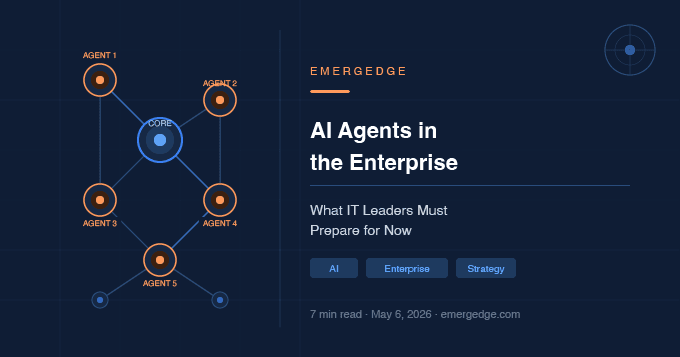
Unlike the AI tools most enterprises have experimented with over the past two years — tools that respond to prompts, generate text, or summarize documents — AI agents act. They plan. They execute multi-step tasks. They call APIs, browse the web, write and run code, and make decisions autonomously to complete a goal.
And they are entering enterprise environments right now, whether IT leaders are ready or not.
What Exactly Is an AI Agent?
An AI agent is a system that perceives its environment, makes decisions, and takes actions to achieve a defined goal — with minimal human intervention at each step.
The simplest way to understand the difference:
- AI tool: You ask it to summarize a report. It summarizes the report.
- AI agent: You tell it to research the top five competitors, summarize their pricing pages, compare them to yours, and send a briefing to the sales team by Friday. It does all of that — autonomously.
Current enterprise examples include agents that autonomously process invoices end to end, handle tier-1 IT support tickets without human involvement, monitor cloud infrastructure and resolve incidents before they escalate, and conduct competitive research and produce structured briefings on a schedule.
This is not speculative. These deployments are happening in production environments today.
Why This Is Different From Previous AI Waves
Every previous AI wave came with a natural throttle — human oversight at the point of action. A generative AI tool could suggest a response, but a human clicked send. It could draft a contract clause, but a lawyer reviewed it. The human was always in the loop at the moment of consequence.
AI agents change this. The defining characteristic of an agent is autonomy over a sequence of actions. The human sets the goal. The agent determines and executes the steps. This is fundamentally different — and it demands a fundamentally different governance response.
The Five Things IT Leaders Must Prepare For
1. Identity and access for non-human entities
AI agents need credentials to do their work. They need access to systems, APIs, databases, email, and calendars. This means your identity and access management infrastructure — built entirely around human users — must now accommodate non-human agents as first-class entities.
Every agent needs a service identity, scoped permissions, audit logging, and a clear owner. Without this, agents will accumulate access quietly, creating exactly the kind of shadow access that security teams spend years trying to eliminate.
2. A new attack surface
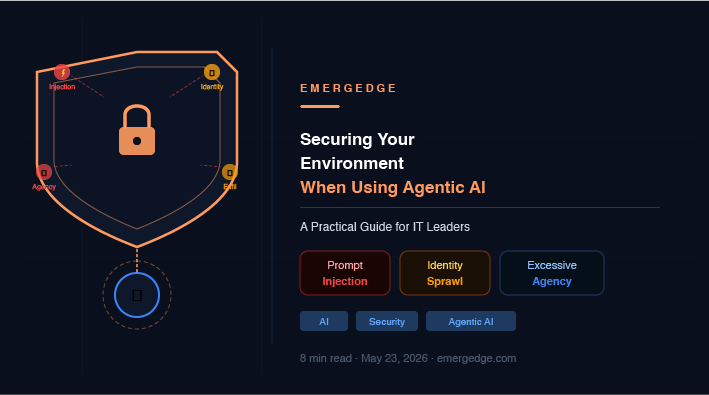
AI agents that browse the web, read emails, and process external documents are exposed to a class of attack called prompt injection — where malicious content in the environment attempts to hijack the agent's behavior by embedding hidden instructions.
Imagine an agent that processes incoming invoices. An attacker embeds hidden text in a PDF that instructs the agent to approve a fraudulent payment. The agent, following its instructions, complies.
This is not theoretical. Security researchers have demonstrated prompt injection attacks against production agent systems. IT security teams need to understand this vector now, not after the first incident.
3. Audit trails for autonomous actions
When a human makes a decision, there is an implicit audit trail — the human. When an agent makes a decision across a chain of autonomous steps, who is accountable? How do you reconstruct what happened and why?
Every enterprise deploying AI agents needs comprehensive logging of agent decisions, actions, and the reasoning behind them. This is not just a security requirement — it is a compliance requirement in any regulated industry.
4. Rate limits and cost controls
AI agents are extremely good at consuming compute. An agent that spins up sub-agents, calls external APIs repeatedly, or gets stuck in a reasoning loop can generate significant costs in minutes. Without hard rate limits and cost controls at the infrastructure level, agent deployments can produce bill shock at a scale that makes cloud cost management look simple.
5. Governance frameworks before deployment
Most enterprises do not have a policy for what AI agents are permitted to do. This needs to exist before the first agent goes into production — not after.
A minimum viable AI agent policy covers what actions agents are permitted to take autonomously versus what requires human approval, which systems agents can access, how agent identities are provisioned and deprovisioned, how agent behavior is monitored and audited, and what the escalation path is when an agent encounters a situat