In 2023, enterprise AI was predominantly a collection of pilots. In 2024, the pilots became production deployments. In 2025, organisations that had successfully deployed AI at scale began to see the competitive gap opening between themselves and those still in the experimentation phase. In 2026, that gap has become structural.
The shift from AI as a capability to AI as an operating system — the layer through which enterprise processes are executed, decisions are made, and value is created — is the defining technology transition of this decade. It changes what IT leaders are responsible for, what the data function needs to deliver, and what governance means in a world where automated systems make consequential decisions at a scale and speed no human team can match.
This post covers the enterprise AI landscape — not the technology for its own sake, but the strategic decisions, architectural choices, and governance frameworks that determine whether AI investments deliver their potential value or become expensive failures.
The Enterprise AI Landscape in 2026
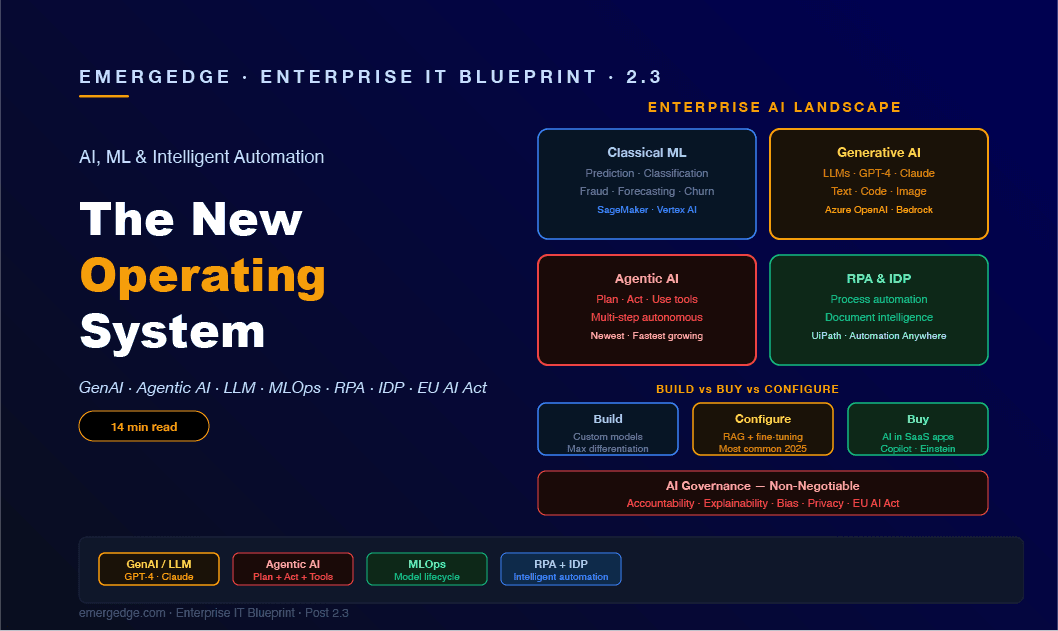
Enterprise AI is no longer a single category. It has matured into a set of distinct but interconnected disciplines, each with its own technology stack, skill requirements, and governance considerations.
Predictive and Classical Machine Learning
Statistical and classical ML approaches — regression, classification, clustering, time series forecasting — remain the workhorses of enterprise AI. They power fraud detection systems, demand forecasting engines, predictive maintenance models, customer churn prediction, and credit scoring systems that have been in production for years and continue to deliver measurable business value.
The platforms in this space — AWS SageMaker, Azure Machine Learning, Google Vertex AI, and Databricks — have matured significantly, reducing the engineering overhead of model development, training, deployment, and monitoring. MLOps — the set of practices that bring software engineering discipline to machine learning model lifecycle management — has moved from a specialist concern to a baseline capability requirement for any organisation with models in production.
Generative AI and Large Language Models
Generative AI — powered by large language models (LLMs) including GPT-4, Claude, Gemini, and their successors — has introduced a categorically different type of AI capability. Where classical ML predicts or classifies based on patterns in training data, generative AI creates: text, code, images, audio, and increasingly, plans and decisions.
For enterprise deployment, the strategic question is not whether to use LLMs but how: which capabilities to build on foundation models via API, which to fine-tune on proprietary data, which to run on private infrastructure for data sovereignty reasons, and how to implement retrieval-augmented generation (RAG) to ground model outputs in organisational knowledge.
The cost and capability landscape has shifted dramatically. Enterprise-quality LLM capability is now available at a fraction of what it cost two years ago. The competitive advantage is no longer in accessing LLM capability — it is in integrating it effectively with organisational data, processes, and governance.
Agentic AI
The most significant development in enterprise AI in the past eighteen months is the emergence of agentic AI systems — AI models that do not simply respond to queries but plan, take actions, use tools, and pursue goals across multi-step processes with varying degrees of human oversight.
Agentic systems integrate LLMs with tools — code interpreters, web browsers, APIs, databases, and communication systems — enabling them to execute workflows that previously required human coordination. A customer service agent that can not only understand a customer's complaint but access their account, identify the issue, initiate a refund, update the CRM, and send a confirmation email — without human intervention — is an agentic AI system.
The enterprise implications are profound. Agentic AI can compress the time required for complex, multi-step knowledge work from hours to seconds. But it also introduces new failure modes — models that pursue goals in unexpected ways, make decisions that are difficult to audit, or take actions with real-world consequences that cannot easily be undone — that require governance frameworks designed specifically for autonomous systems.
Robotic Process Automation and Intelligent Document Processing
RPA has been in enterprise deployment longer than generative AI, and it remains a significant source of automation value — particularly for high-volume, rule-based processes involving legacy systems with no API. The category has evolved significantly: modern RPA platforms (UiPath, Automation Anywhere, Blue Prism) have integrated AI capabilities — computer vision, NLP, and increasingly LLM-based processing — creating what is now commonly called intelligent automation.
Intelligent document processing (IDP) — the automated extraction, classification, and validation of information from unstructured documents — has been transformed by LLMs. Tasks that required weeks of template training and frequent exception handling can now be addressed by general-purpose models that understand document context without explicit training.
The Build vs Buy Decision
Every enterprise AI initiative faces the same foundational question: build, buy, or configure?
Build — developing custom models on proprietary data — delivers the highest differentiation but requires significant data science capability, infrastructure, and operational discipline. Appropriate for use cases where proprietary data creates a genuine competitive advantage and where the investment in model development and maintenance is justified by business value.
Buy — purchasing AI capabilities as a service from vendors — reduces implementation time and skill requirements but typically delivers less differentiation. The majority of enterprise AI deployments in 2025 are in this category: AI features embedded in SaaS applications (Salesforce Einstein, Microsoft Copilot, ServiceNow AI), industry-specific AI platforms, and foundation model APIs.
Configure — using foundation model APIs with custom prompting, fine-tuning, or RAG — sits between build and buy. It provides access to state-of-the-art model capability while allowing customisation with organisational data and context. The emergence of enterprise AI platforms (Azure OpenAI, Amazon Bedrock, Google Vertex AI) has made this approach accessible to organisations without deep ML engineering capability.
AI Governance — The Non-Negotiable Layer
Every enterprise AI deployment requires a governance framework that addresses four questions:
Accountability: Who is responsible when an AI system makes a harmful or incorrect decision? In human processes, accountability is clear. In AI-assisted processes, it must be explicitly defined — typically through a human-in-the-loop requirement for high-stakes decisions.
Explainability: Can the AI system's decisions be explained in terms that the people affected by them can understand? Regulatory requirements in financial services, healthcare, and increasingly other sectors require that automated decisions be explainable. Black-box models that cannot provide explanations are increasingly legally problematic.
Bias and fairness: Does the AI system treat different groups of people differently in ways that are unjustified or harmful? AI systems trained on historical data can perpetuate and amplify historical biases. Governance frameworks must include bias testing, ongoing monitoring, and remediation processes.
Data privacy: Does the AI system use personal data in ways that comply with applicable regulations? LLMs that are fine-tuned on or prompted with customer data require careful privacy analysis, particularly under GDPR, DPDP, and similar frameworks.
The EU AI Act — which came into force in 2024 and is in phased implementation — establishes binding requirements for high-risk AI applications in regulated domains. Organisations deploying AI in hiring, credit decisions, law enforcement, healthcare, and critical infrastructure must comply with documentation, testing, and human oversight requirements that have significant implementation implications.
The Magic Quadrant Landscape
AI and ML Platforms
Gartner's Magic Quadrant for Cloud AI Developer Services identifies Microsoft Azure AI, Google Vertex AI, and Amazon SageMaker as consistent Leaders. Databricks occupies a strong Visionary position, driven by its unified data and AI platform and the success of the open-source MLflow project.
The defining differentiator in 2025 is the degree to which platforms have integrated LLM capability with classical ML infrastructure — enabling organisations to build hybrid AI applications that combine the reliability of classical ML with the flexibility of generative AI.
Vendor Comparison
| Dimension | Azure AI / OpenAI | AWS Bedrock / SageMaker | Google Vertex AI | Databricks | UiPath (RPA/Agentic) |
|---|---|---|---|---|---|
| LLM / GenAI | ★★★★★ | ★★★★☆ | ★★★★★ | ★★★★☆ | ★★★☆☆ |
| Classical ML | ★★★★☆ | ★★★★★ | ★★★★★ | ★★★★★ | ★★☆☆☆ |
| MLOps | ★★★★☆ | ★★★★★ | ★★★★☆ | ★★★★★ | ★★★☆☆ |
| Agentic AI | ★★★★★ | ★★★★☆ | ★★★★☆ | ★★★☆☆ | ★★★★★ |
| Enterprise integration | ★★★★★ | ★★★★☆ | ★★★★☆ | ★★★★☆ | ★★★★★ |
| Data platform integration | ★★★★☆ | ★★★★☆ | ★★★★★ | ★★★★★ | ★★★☆☆ |
| Governance & compliance | ★★★★☆ | ★★★★☆ | ★★★★☆ | ★★★★☆ | ★★★★☆ |
| Best for | M365 orgs, GPT access | AWS-native AI, broadest ML | Data-first AI, BigQuery | Unified data+AI | Enterprise RPA + agentic |
What to Do Next
Three questions for IT leaders building enterprise AI capability:
1. Do you have a named AI governance owner — a person or committee with explicit accountability for AI risk, bias, explainability, and regulatory compliance? Without governance ownership, AI deployments accumulate risk invisibly until an incident makes it visible.
2. What is the data quality of the systems your AI models depend on? AI systems inherit the quality problems of their training data and input feeds. Investing in AI before investing in data quality is investing in a faster way to make incorrect decisions.
3. Are your AI pilots delivering measurable business value, or are they delivering interesting demonstrations? The test of enterprise AI maturity is not the number of pilots — it is the number of AI capabilities that have been deployed to production and are generating measurable outcomes.