Ask most enterprise architects to name the frameworks they know, and the list is predictable: TOGAF, Zachman, sometimes ArchiMate. Almost none will mention FEAF — despite the fact that it governs the architecture practice of one of the largest, most complex, most heavily scrutinised IT estates on the planet: the entire U.S. federal government.
That obscurity outside government circles is not because FEAF is a minor framework. It is because FEAF was built for a specific, narrow purpose that most private-sector architects never encounter directly: giving a central budget authority — the Office of Management and Budget — a consistent way to compare IT investments across hundreds of agencies and eliminate the redundant spending that happens when everyone solves the same problem independently.
Understanding FEAF is directly useful if you work with, sell to, or consult for federal or public-sector organisations. It is also a genuinely useful lens even if you never touch a government contract — because the problem FEAF was built to solve (duplicated investment across a large, decentralised organisation) is exactly the problem most large enterprises face internally, across their own business units.
Why FEAF Exists
FEAF's origin is legislative, not technical. The Clinger-Cohen Act of 1996 required federal agency Chief Information Officers to develop, maintain, and facilitate an integrated enterprise architecture — a direct response to decades of federal IT projects that ran over budget, delivered late, or duplicated capability that another agency had already built.
The Federal CIO Council published the original Federal Enterprise Architecture Framework in 1999, followed by a set of reference models through the early 2000s. In 2013, the Office of Management and Budget consolidated and modernised the framework into FEAF2 — the current version — introducing the Consolidated Reference Model and the Collaborative Planning Methodology that define FEAF today.
The throughline across every version: FEAF exists to serve federal budget governance. Every reference model, every planning step, ultimately feeds into the OMB investment review process (Exhibit 300 and Exhibit 53) that determines which federal IT investments get funded.
The Six Consolidated Reference Models
FEAF2 organises everything an agency needs to describe about itself into six reference models — a shared vocabulary that lets OMB and agencies compare architecture across the whole of government:
Performance (PRM) — links investment activity to measurable mission outcomes, so spending can be justified by results rather than activity.
Business (BRM) — describes government functions independently of which agency performs them, surfacing when multiple agencies are quietly doing the same thing.
Data (DRM) — a standard way to describe, discover, and share data across agency boundaries.
Application (ARM) — catalogues applications and systems to identify reuse opportunities and duplicative investment.
Infrastructure (IRM) — standardises the technology and platform choices — including cloud — that underpin agency systems.
Security (SRM) — a common language for security and privacy, aligned to NIST's risk management framework.
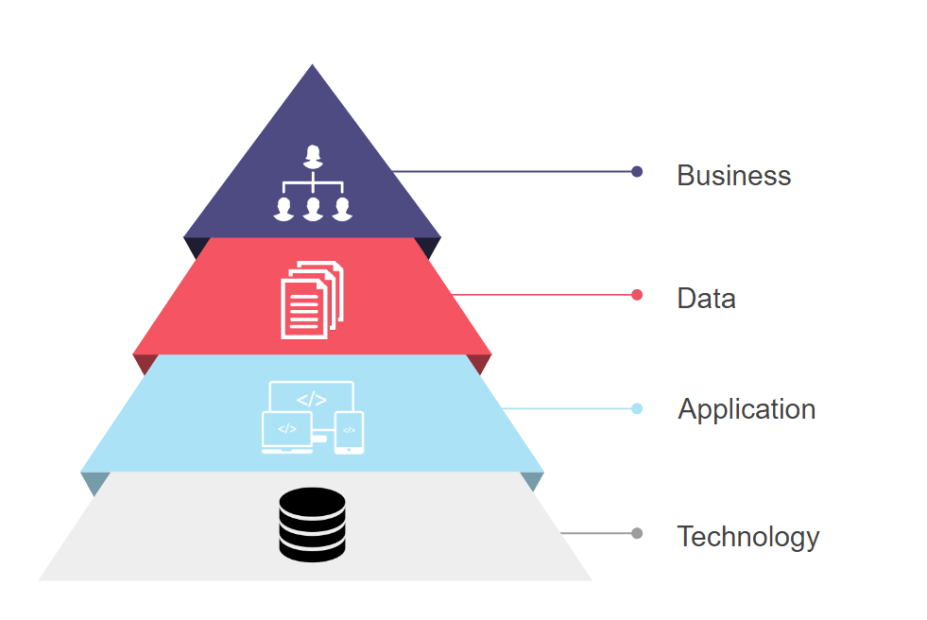
The organising insight behind all six: an investment cannot be properly evaluated in isolation. Placing every agency's business functions, data, applications, infrastructure, and security posture into the same six-model structure is what makes cross-government comparison possible in the first place.
The Collaborative Planning Methodology
Where TOGAF has the ADM as its central process, FEAF2 has the Collaborative Planning Methodology (CPM) — an iterative planning cycle that runs from identifying a mission problem through to measuring whether the resulting investment actually delivered value, with the results feeding directly back into the next planning cycle.
The CPM is explicitly collaborative — every step is designed to involve planners, business owners, system designers, and implementers together, rather than architecture being produced centrally and handed down. And critically, it is not a one-time project exercise: performance measurement closes the loop back into the next iteration of problem identification, making architecture an ongoing discipline tied to budget cycles rather than a document produced once and shelved.
Segment and Solution Architecture
FEAF distinguishes three levels of architectural scope, and knowing which level a piece of work belongs to determines who owns it and how it should be governed.
Enterprise architecture is the whole-of-government or whole-of-agency view — the reference models and standards everything else aligns to.
Segment architecture covers a specific mission area or shared service — Grants Management or Human Resources Management, for example — often spanning multiple agencies, and is where FEAF's cross-agency shared-services goal is actually realised in practice.
Solution architecture is the most granular level — a specific system or investment, owned by a delivery team, that must align to its parent segment and to the enterprise reference models.
The failure mode FEAF is designed to prevent is solution architectures built in isolation, with no segment-level alignment — which is precisely how large organisations, government or otherwise, end up funding a dozen different systems that all solve the same problem.
FEAF, TOGAF, and Zachman — Complementary, Not Competing
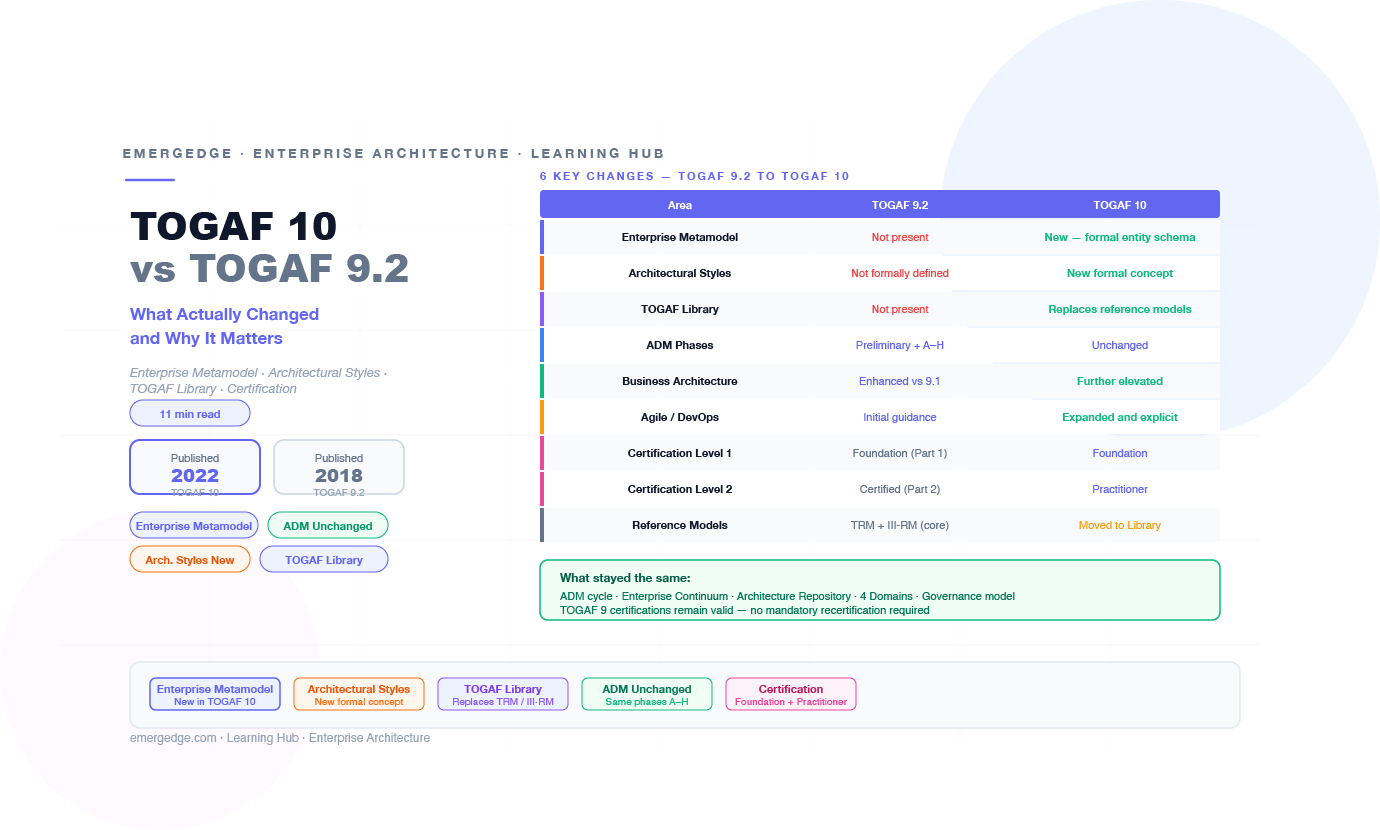
FEAF is not a replacement for TOGAF or Zachman, and in practice federal agencies frequently use all three together: TOGAF's ADM as the working method for developing architecture, Zachman to classify the resulting artefacts by stakeholder perspective, and FEAF's reference models as the reporting structure that satisfies OMB requirements and enables cross-agency comparison.
The distinction that matters most: TOGAF and Zachman are general-purpose, adopted voluntarily by any organisation. FEAF is specific to U.S. federal agencies and mandatory under the Clinger-Cohen Act — its investment-governance linkage is not something either of the other two frameworks provides natively.
A New Interactive Study Guide — FEAF on the Learning Hub
This post is paired with a new addition to the EmergEdge Learning Hub: a complete interactive FEAF study manual — the same format as the existing TOGAF, ArchiMate, and Zachman guides.
It covers all six Consolidated Reference Models in depth, walks through the Collaborative Planning Methodology step by step, breaks down segment versus solution architecture with practical examples, and includes a direct comparison against TOGAF and Zachman. Twenty-eight flash cards let you test recall across every section.
→ Explore the FEAF Interactive Study Guide
If you work with public-sector clients, hold a federal contract, or are simply building out your enterprise architecture credentials beyond the frameworks everyone already knows, this is the one most of your peers have not studied yet.