A datacenter can have fully redundant power paths, enterprise-grade UPS systems, precision-cooled racks, and a generator capable of running the facility for days — and still suffer cascading equipment failures, unexplained thermal events, and premature hardware degradation that none of its monitoring systems will ever correctly attribute to their actual cause.
Harmonics.
In the era of AI-driven infrastructure, high-density GPU clusters, and the relentless proliferation of switch-mode power supplies, harmonic distortion has become one of the most consequential and least discussed risks in enterprise datacenter power design. It operates silently, accumulates invisibly, and manifests in symptoms that look like cooling problems, power supply failures, or mysterious uptime incidents — until someone measures Total Harmonic Distortion (THD) and finds levels that explain everything.
This post covers what harmonics are, how they propagate through the datacenter power distribution hierarchy, why they matter at every level from the utility connection to the server chassis, and what filtering strategies effectively address them.
What Harmonics Are and Why They Exist
Electrical power is supplied as a sinusoidal alternating current at a fundamental frequency — 50Hz in most of the world, 60Hz in North America. Harmonics are additional frequency components that appear in the electrical system at integer multiples of that fundamental: the 2nd harmonic at 100Hz, the 3rd at 150Hz, the 5th at 250Hz, and so on.
They are not a product of poor power supply quality from the utility. They are generated by the loads themselves — specifically by non-linear loads that do not draw current in a smooth sinusoidal pattern proportional to the applied voltage.
In a modern datacenter, the dominant sources of harmonic distortion are server power supplies (switched-mode power supplies draw current in sharp pulses rather than sinusoidal waves), UPS systems, variable frequency drives used in cooling systems, LED lighting, and the rectifiers and inverters of the power distribution infrastructure itself. A single server may produce modest harmonic content, but a fully populated 42U rack of servers with high-density PSUs generates significant distortion — and a hall of hundreds of racks creates a harmonic environment that, without active management, will degrade every element of the electrical infrastructure it connects to.
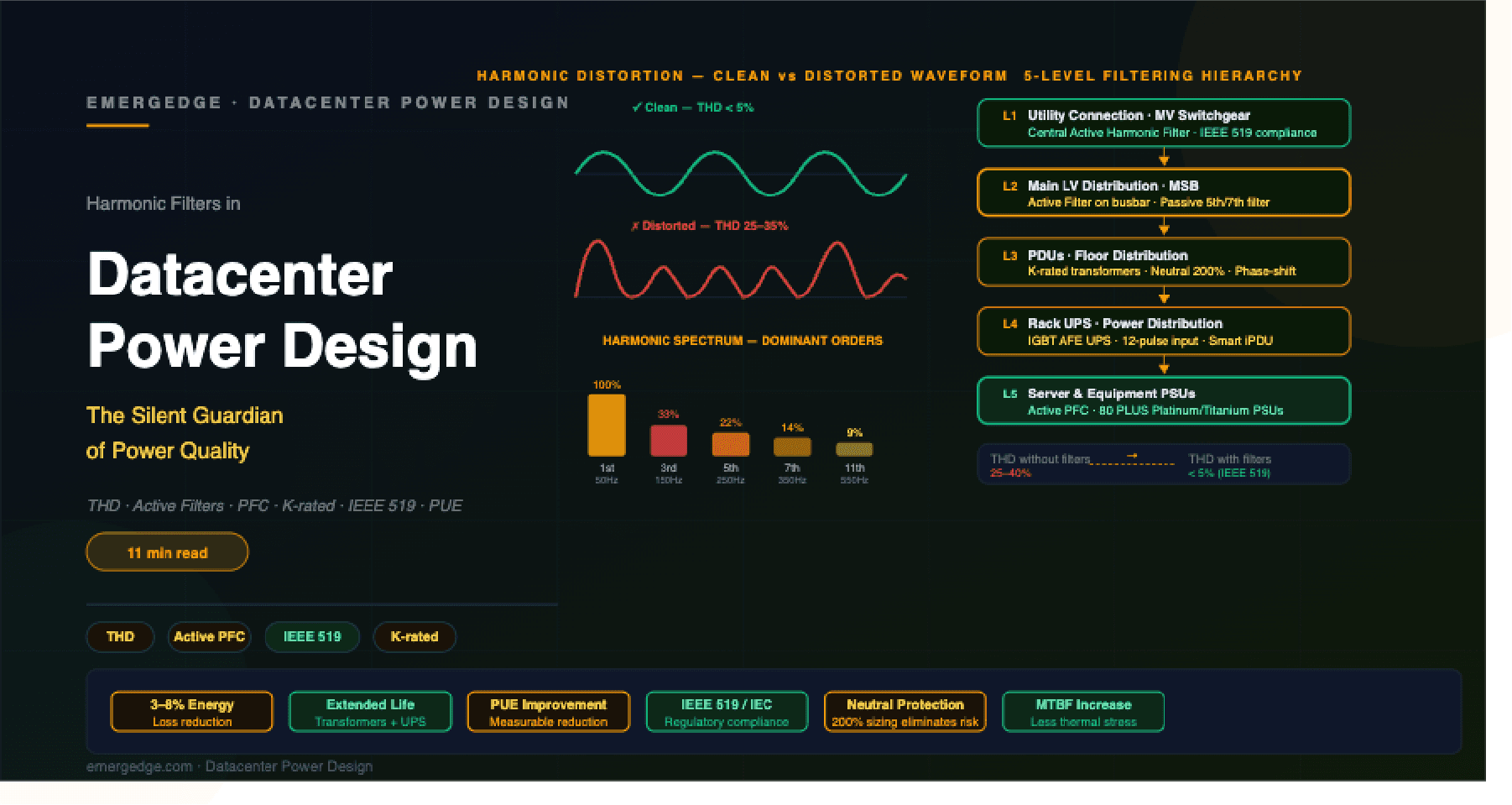
The standard measure of harmonic severity is Total Harmonic Distortion (THD) — the ratio of the combined power of all harmonic frequencies to the power of the fundamental frequency, expressed as a percentage. IEEE 519 sets limits for acceptable THD in commercial and industrial installations: typically 5% THD at the point of common coupling (PCC) for facilities connected to the utility grid.
Many datacenters, measured honestly, significantly exceed this limit.
The Consequences of Unmanaged Harmonics
Before examining the benefits of filtering at each level, it is worth being specific about what unmanaged harmonic distortion actually costs.
Transformer overheating and derating. Transformers are designed for fundamental frequency current. Harmonic currents, particularly the 3rd, 5th, and 7th harmonics, create additional eddy current losses in transformer cores and windings. These losses manifest as heat. A transformer operating at its nameplate rating with 15% THD may be running 20-30°C hotter than its design specification. Over time, this accelerates insulation degradation, reduces transformer lifespan, and creates fire risk. Transformers in harmonic-rich environments must be derated — typically operating at 70-80% of nameplate capacity — to maintain safe operating temperatures.
Neutral conductor overloading. In three-phase systems, balanced fundamental-frequency currents cancel in the neutral conductor. The 3rd harmonic and all triplen harmonics (3rd, 9th, 15th...) do not cancel — they add in the neutral. In a datacenter with high 3rd harmonic content, neutral conductor current can reach 150-200% of phase conductor current. A neutral conductor sized for balanced load cancellation will overheat under these conditions. This is one of the most common causes of unexplained electrical infrastructure failures in dense datacenter environments.
Capacitor bank failures. Power factor correction capacitors resonate with system inductance at harmonic frequencies. When the resonant frequency coincides with a dominant harmonic — most commonly the 5th (250Hz/300Hz) — the capacitor bank amplifies rather than absorbs harmonic current. This harmonic amplification can destroy capacitor banks rapidly and catastrophically. Any facility with power factor correction capacitors and significant non-linear load requires harmonic analysis before those capacitors are energised.
UPS system stress. UPS systems both generate harmonics (their rectifiers are significant sources) and are affected by them. Harmonic distortion in the input supply degrades UPS efficiency, increases component stress in rectifier circuits, and can cause nuisance tripping of protective devices. In double-conversion UPS systems, harmonics on the bypass source create voltage distortion that propagates to the protected load when the system transfers to bypass.
Server and equipment degradation. At the equipment level, voltage distortion from harmonics causes increased heating in equipment power supplies, interference with sensitive electronics, zero-crossing errors in timing circuits, and in severe cases, data corruption and equipment malfunction. The cumulative effect on Mean Time Between Failure (MTBF) of IT equipment in high-harmonic environments is measurable and significant.
Energy waste. Harmonic currents increase RMS current in conductors without contributing useful power. This reactive harmonic power is real energy consumption — it heats conductors and transformers — but delivers no work. The energy penalty for unmanaged harmonic distortion in a large datacenter is substantial: studies consistently show 3-8% energy waste attributable to harmonic losses in facilities without harmonic mitigation.
Harmonics at Every Level of the Power Distribution Chain
Level 1 — Utility Connection and Medium Voltage Switchgear
At the utility connection point, the datacenter presents as a large non-linear load to the grid. Harmonic currents injected into the utility system affect neighbouring facilities sharing the same distribution transformer — a concern that regulators increasingly enforce through standards like IEEE 519 and IEC 61000-3.
Filtering strategy at this level: Passive harmonic filters (tuned to the dominant harmonics) or active harmonic filters sized for the full facility load are installed at the main point of common coupling. For large hyperscale facilities, multi-megawatt active filter systems coordinate with utility protection systems. The objective is to limit current THD injected into the utility to within IEEE 519 limits and protect the facility's own medium voltage distribution infrastructure.
Level 2 — Main Low Voltage Distribution and Main Switchboard
At the main LV switchboard, harmonic currents from all downstream non-linear loads aggregate. This is typically where the worst harmonic environment in the facility exists — and where the consequences for transformers, main cables, and protective devices are most severe.
Filtering strategy at this level: Central active harmonic filters connected to the main busbar provide broadband harmonic mitigation across multiple harmonic orders simultaneously. Active filters measure the harmonic content in real time and inject equal-and-opposite harmonic currents to cancel the distortion. Modern active harmonic filters respond in microseconds and can reduce THD from levels of 30-40% to below 5% at the main busboard.
For facilities with large motor loads (chiller plants, cooling towers), passive 5th and 7th harmonic filters detuned slightly below resonance provide cost-effective mitigation for the dominant harmonic orders from variable frequency drives.
Level 3 — Power Distribution Units (PDUs) and Floor Distribution
At the PDU level, harmonic currents are at their most granular — generated by individual server PSUs, network equipment, and storage systems. The 3rd harmonic is particularly dominant at this level, driven by single-phase switch-mode power supplies that draw current only at the peak of each voltage cycle.
Filtering strategy at this level: Several approaches are applied here:
K-rated transformers within PDUs are designed to handle non-sinusoidal currents without excessive heating. K-13 and K-20 rated transformers are the standard specification for IT load environments.
Neutral-oversizing — specifying neutral conductors at 200% of phase conductor ampacity — provides a straightforward design response to the triplen harmonic neutral overcurrent problem without active filtering.
Phase-shifting transformers (zigzag and delta-star combinations) cancel specific harmonic orders by introducing a phase shift between parallel power distribution paths. A 30-degree phase shift between two distribution paths cancels 5th and 7th harmonics through mutual cancellation. This is particularly effective in large, symmetrically loaded installations.
Level 4 — Rack Power Distribution and UPS Systems
At the rack level, individual UPS systems protecting critical loads and the power supplies within the rack itself are both harmonic sources and harmonic victims.
Filtering strategy at this level:
Modern double-conversion UPS systems with IGBT-based active front ends (AFE) have largely replaced the older thyristor-based rectifiers as the standard for enterprise datacenter UPS. AFE rectifiers draw near-unity-power-factor sinusoidal current from the supply, generating input THD of less than 3% compared to 25-30% for older 6-pulse thyristor designs. For facilities with legacy UPS infrastructure, retrofit 12-pulse input transformer configurations or input-side active filters reduce harmonic injection at the UPS input without full UPS replacement.
Rack-level harmonic filtering — integrated into intelligent PDUs — is an emerging category that provides real-time THD monitoring, capacitive reactive power compensation, and in some products, active harmonic filtering at the outlet level.
Level 5 — Server and Equipment PSUs
At the equipment level, Power Factor Correction (PFC) circuits within individual server power supplies address the harmonic generation problem at its source.
Active PFC in modern server PSUs — now standard in all major server platforms compliant with 80 PLUS Gold, Platinum, and Titanium certifications — shapes the input current draw to closely approximate a sinusoid, reducing PSU-level THD to below 5%. This represents the single most impactful harmonic mitigation development of the past decade. The widespread adoption of high-efficiency PSUs with active PFC has reduced the per-server harmonic footprint dramatically compared to legacy equipment.
However, active PFC does not eliminate the problem at scale — the aggregate effect of thousands of PSUs in a hyperscale environment still creates measurable harmonic distortion — and legacy equipment without active PFC remains a significant source in mixed-age environments.
Selecting the Right Filtering Strategy
The filtering strategy appropriate for a datacenter depends on three primary factors: the scale of the installation, the harmonic profile of the specific loads, and the point in the design lifecycle at which harmonic mitigation is being considered.
New designs should address harmonics at every level of the distribution hierarchy from the outset. This means specifying K-rated transformers, neutral oversizing, AFE UPS systems, active PFC-equipped server hardware, and central active harmonic filters at the main distribution level. The incremental cost of designing for harmonic mitigation from the start is a fraction of the retrofit cost.
Existing facilities with identified harmonic problems typically benefit most from active harmonic filter installation at the main LV distribution level — providing the broadest harmonic coverage with the least disruptive installation. Facilities with dominant motor loads from cooling systems benefit from passive 5th/7th harmonic filters on VFD inputs.
Mixed environments — older facility infrastructure with modern high-density IT loads — require harmonic surveys as a prerequisite for any mitigation investment. THD measurements at multiple points in the distribution hierarchy, combined with harmonic spectrum analysis, identify the dominant harmonic orders and their sources before any filtering specification is finalised.
The Business Case for Harmonic Mitigation
The return on investment for harmonic filtering in a properly designed datacenter is compelling and calculable.
Energy savings of 3-8% on electrical infrastructure losses, conservatively valued at the facility's blended electricity rate, typically represent the largest line item in the business case. For a 10MW datacenter at an average electricity cost of $0.08/kWh, a 5% energy saving attributable to harmonic mitigation represents approximately $350,000 per year.
Extended equipment lifespan — transformers, UPS systems, capacitor banks, and cabling — from reduced thermal stress. A transformer operating at design temperature rather than 25°C above it will last significantly longer than its thermally stressed equivalent. The avoided capital replacement costs over a 10-15 year facility lifecycle are substantial.
Reduced maintenance costs from fewer unexplained failures, less nuisance tripping of protective devices, and lower frequency of neutral conductor thermal events.
Regulatory compliance with IEEE 519, IEC 61000, and grid operator requirements — avoiding potential utility penalties and demonstrating responsible power consumption to regulators and sustainability stakeholders.
PUE improvement — Power Usage Effectiveness, the standard datacenter efficiency metric, is directly improved by reducing harmonic losses. For facilities with sustainability commitments, the PUE impact of harmonic mitigation contributes measurably to reported efficiency improvements.
Conclusion
Harmonic distortion is not a niche electrical engineering concern. In modern datacenters with high-density non-linear loads, it is a primary driver of infrastructure degradation, energy waste, and premature equipment failure. The good news is that it is entirely addressable — at every level of the power distribution chain, with mature, proven technology.
The datacenter teams that treat power quality as a first-class design concern — integrating harmonic analysis, K-rated equipment specifications, neutral oversizing, AFE UPS systems, and active harmonic filters into their standard design practice — operate facilities that are more efficient, more reliable, and more resilient than those that treat harmonics as an afterthought.
In a domain where uptime is measured in nines and the cost of downtime is measured in millions, that is not a marginal consideration. It is a design requirement.