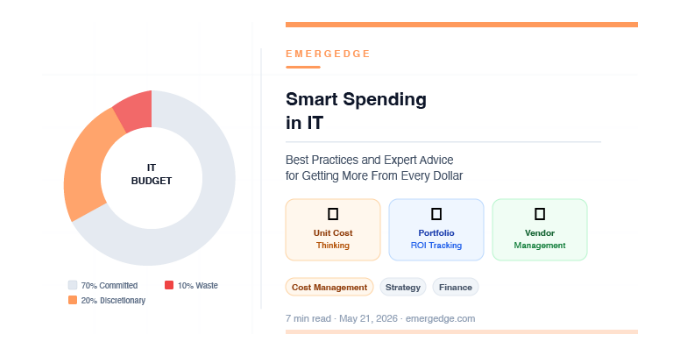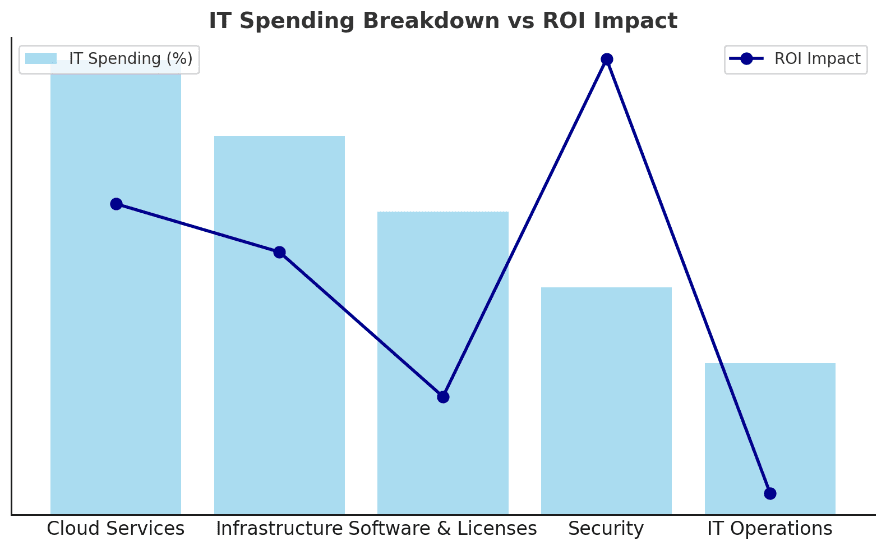
Cost-cutting alone does not equate to long-term IT savings. Instead, businesses must focus on maximizing ROI by optimizing operations, vendor contracts, cloud workloads, and asset lifecycles. A data-driven approach to IT spending ensures efficiency without compromising service quality or innovation.
Introduction
As IT budgets face increasing scrutiny, CIOs and IT leaders must rethink cost-saving strategies beyond traditional budget cuts. The challenge is not just to spend less but to spend smarter — ensuring every dollar invested in IT delivers maximum business value. This post explores practical strategies to optimize IT investments without sacrificing performance.
1. Optimizing IT Operations Without Downgrading Services
Many organizations cut IT budgets reactively, leading to reduced service quality, security risks, and operational inefficiencies. Instead, businesses should:
- Automate routine tasks to reduce manual workload using AIOps and RPA
- Consolidate IT tools and platforms to avoid redundancy
- Invest in proactive monitoring to prevent costly outages and downtime
2. Cloud Cost Management Through Smarter Workload Distribution
Cloud costs are among the biggest IT expenditures. Instead of simply reducing cloud services, organizations should optimize workload placement and resource allocation:
- Leverage cloud cost analysis tools and FinOps practices to identify wastage
- Use reserved instances and auto-scaling to match real-time demand
- Reassess multi-cloud versus hybrid-cloud strategies based on cost efficiency
3. Strategic Vendor Negotiations and Contract Optimization
Vendor contracts often include hidden costs and long-term lock-ins. IT leaders can negotiate better deals by:
- Benchmarking vendor pricing against industry standards
- Seeking performance-based contracts and pay-for-value models
- Consolidating vendor agreements for better pricing power
4. Enhancing IT Asset Utilization and Lifecycle Management
IT hardware and software often get replaced prematurely, leading to unnecessary expenses. A structured asset lifecycle strategy can reduce costs:
- Extend hardware life with predictive maintenance
- Leverage refurbished enterprise-grade equipment where feasible
- Implement IT asset tracking to avoid underutilized resources
5. Data-Driven Decision-Making for IT Budget Efficiency
Cost-saving decisions should be based on data, not assumptions. Organizations should:
- Use analytics to track IT spending trends and ROI
- Identify underperforming investments and reallocate funds
- Develop a cost-optimization framework tied to business goals
Conclusion
The future of IT cost optimization is about balancing efficiency with innovation. By focusing on smart investments, strategic vendor management, and data-driven insights, IT leaders can ensure their budgets are optimized without compromising growth, security, or service quality.