In the monthly status review, every project is green. The dashboard looks healthy, the sponsors are satisfied, and yet very little has shipped this quarter.
This is the quiet failure of many IT portfolios. No single project is in trouble, but the portfolio as a whole is not delivering. The cause is rarely a lack of effort or a missing tool. It is a lack of choices.
Project, Program, Portfolio
Three levels of management are often blurred together, and each answers a different question.
| Level | The question it answers |
|---|---|
| Project | Are we delivering this work to scope, time and cost? |
| Program | Are related projects delivering their combined benefit? |
| Portfolio | Are we funding the right work, within our capacity, for our strategy? |
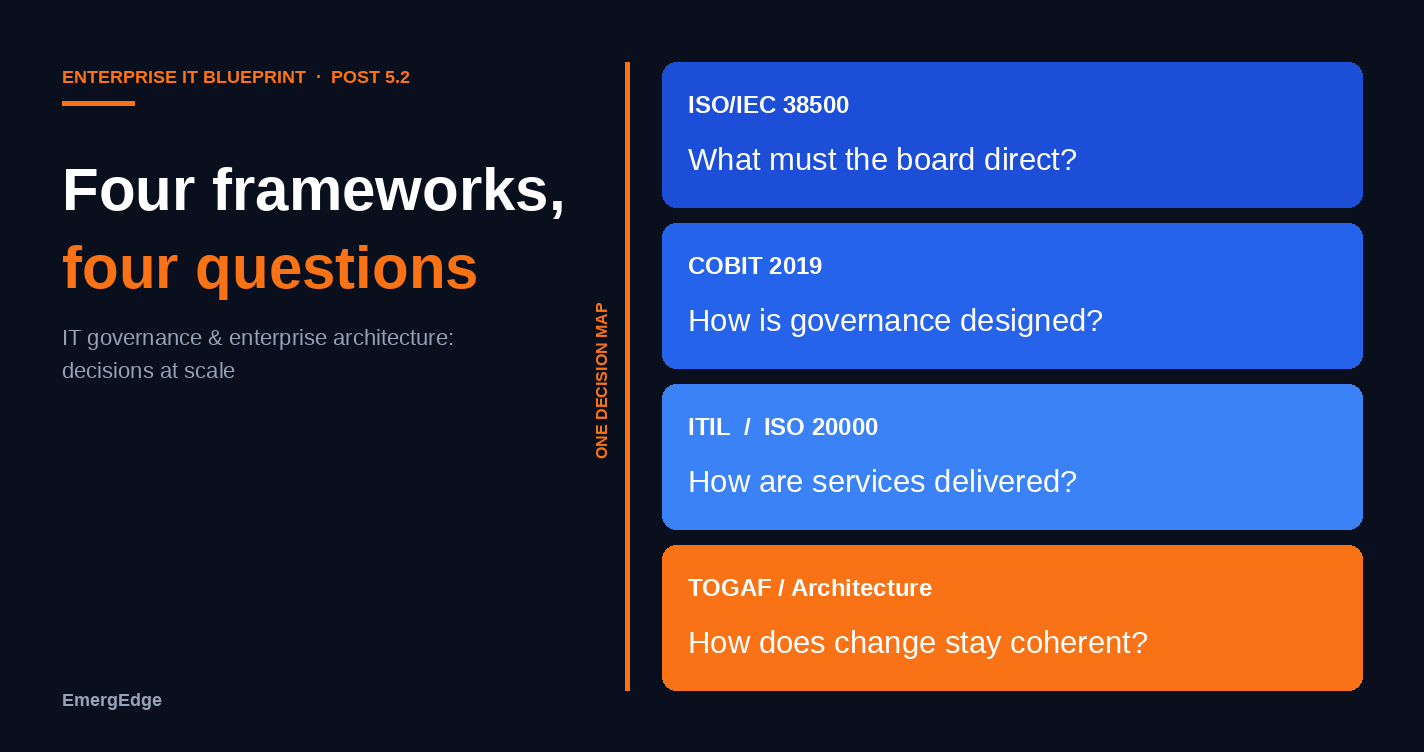
| Governance (Posts 5.0 and 5.2) | Who decides, and where are exceptions approved? |
If project and program management are about doing the work right, portfolio management is about doing the right work. A flawless project can still be the wrong investment, and no amount of good delivery fixes that.
Why This Gets Harder, Not Easier
PMI's 2026 Pulse of the Profession, "Driving Success in Complex Projects", reports that nearly one third (31%) of complex projects fail to achieve the full scope of their intended benefits, more than twice the rate reported for projects overall. PMI also reports that more than half of all projects now qualify as complex, and that 81% of project professionals say projects have become more complex in recent years.
The point for a portfolio is that complexity raises the price of poor prioritisation. Every extra project adds dependencies, competes for the same scarce teams, and increases the chance that benefits are diluted. PMI describes the project management office as an enterprise "execution hub" that helps align sponsors and govern trade-offs. That is a portfolio role, not a reporting role.
Four Portfolio Decisions
A portfolio is managed through a small number of decisions. Settle these, and most of the rest follows.
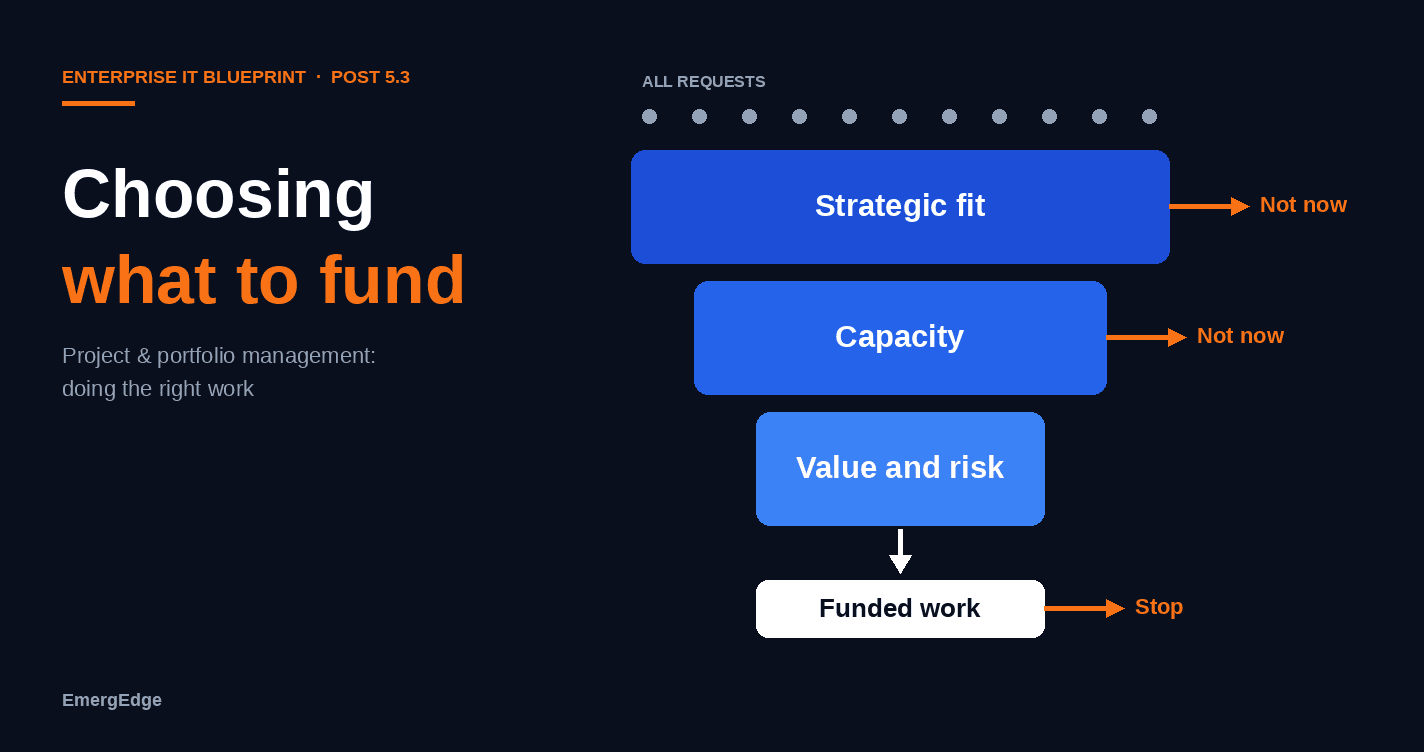
1. How is work scored? Agree a short set of criteria and use them for every request. Three or four is enough: strategic fit, expected value, risk, and effort. A long scorecard becomes a negotiation tool rather than a decision tool. What matters is consistency, so that two similar requests receive the same treatment.
2. Who may say no, and where do requests enter? If sponsors can approve work through side channels, the portfolio has no front door. Define one intake route and name the role that can decline or defer a request. Without the authority to say no, prioritisation is only a ranking that nobody has to follow. This ties directly to the decision rights discussed in Post 5.0 and the decision map in Post 5.2.
3. Is capacity treated as a hard limit? Count capacity for the scarce teams, such as security, integration, infrastructure and a few key specialists, not for each project in isolation. A portfolio can look affordable in money and impossible in people. If the same ten people are booked on every project, every project will slip at the same time.
4. When is a running project stopped? Most portfolios have a start process and no stop process. Define review points and stop criteria in advance: strategy has changed, the business case no longer holds, or capacity is needed for higher-value work. Ending a project is not a failure of the project. It is the portfolio doing its job.
An Illustrative Example: Everything Is Priority One
The following is a composite scenario, not a description of any one organisation.
An IT organisation approves every request that a senior sponsor supports. Around forty items run in parallel, all drawing on the same infrastructure, security and integration teams. Each project reports green in isolation, but delivery slips everywhere, because the same few people are booked on all of them.
The review that finally helps does not introduce a new tool. It counts capacity per scarce team, ranks the work on three criteria, and stops two projects that no longer serve the strategy. Within a quarter, fewer things are in flight, and more of them finish.
A One-Page Portfolio Check
You can test your own portfolio with six questions:
- Intake: Is there one route for new requests, and does everyone use it?
- Scoring: Are requests assessed on the same three or four criteria?
- Capacity: Can you see demand against the capacity of your scarcest teams?
- Review cadence: How often is the whole portfolio reviewed, not just each project?
- Stop rule: What would cause a running project to be paused or ended, and who decides?
- Benefits: Are benefits tracked after go-live, or does tracking end at delivery?
If you cannot answer two or more, the portfolio is probably managing itself by default.
What This Means for IT Leaders
Project success and portfolio success are different things. You can deliver every project well and still fund the wrong set of work. The leadership task is to make a small number of explicit choices: what to start, what to defer, and what to stop.
A portfolio is working when saying no is a normal, respected decision rather than a political event.
Next in the series, Post 5.4 compares IT service management platforms, looking at how to evaluate them and where independent evidence differs from analyst research.
Sources: PMI, "Why Complex Projects Fail: Best Practices Are Not Enough, System Thinking Gives Your Team the Edge" (press release on the 16th edition of the Pulse of the Profession, May 12, 2026); PMI, The Standard for Portfolio Management (overview).