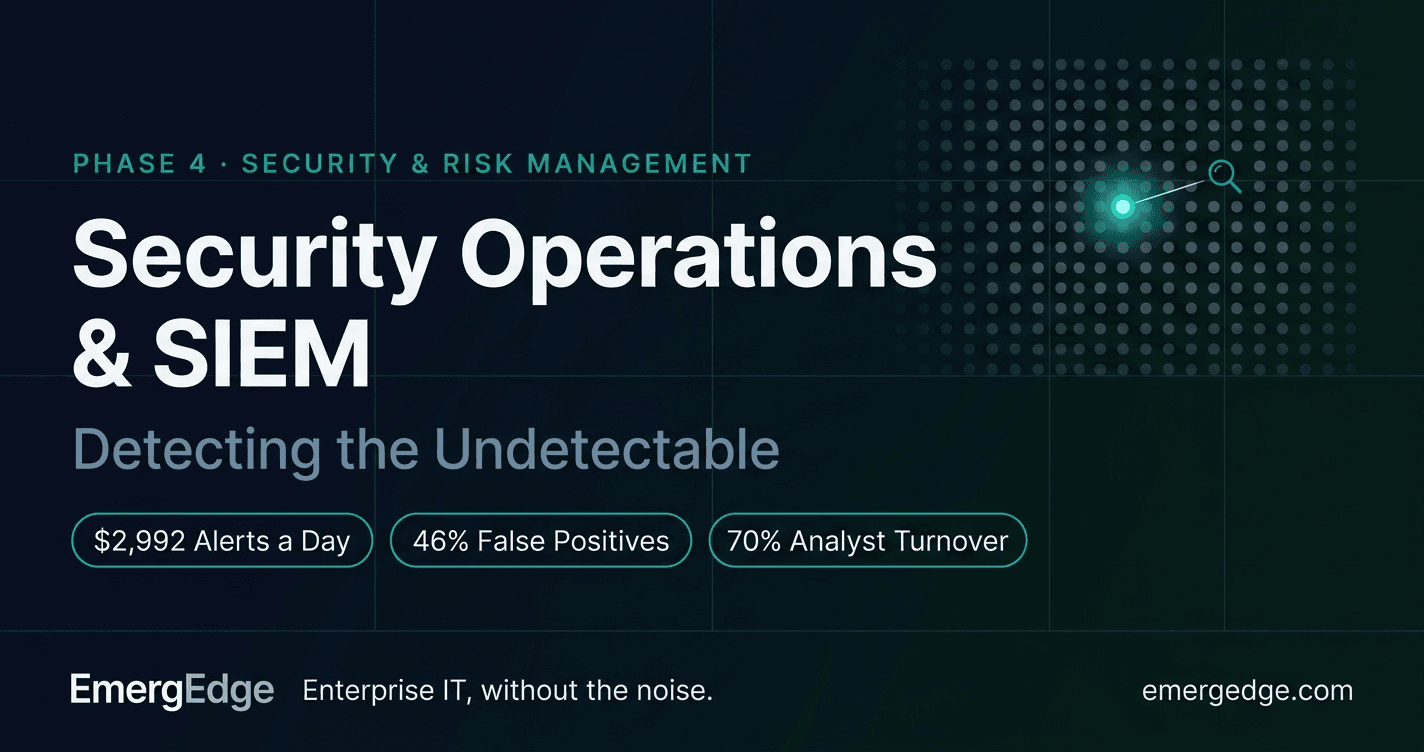
The average organisation now faces roughly 2,992 security alerts a day — down from 4,484 in 2023, which sounds like progress until you notice that even the improved number is still three thousand alerts every single day. Forty-six percent of those alerts are false positives. Up to 63% never get investigated at all, simply because no team has the capacity. Forty-nine percent of SOC analysts cite alert fatigue as their single biggest challenge, and seventy percent of junior analysts leave the profession within three years. The detection tooling isn't the bottleneck anymore. The humans asked to act on what it detects are.
Post 4.3 covered gaining visibility into cloud workloads and identities. This post covers what happens once that visibility — plus everything else: endpoint telemetry, network traffic, identity logs, application data — actually has to be correlated, triaged, and acted on by a team that can't physically read three thousand alerts a day and still function.
What Security Operations Actually Has to Solve
The problem was never a lack of data. Modern enterprises generate more security telemetry than at any point in history — every endpoint, every cloud workload, every identity event, every network flow logged somewhere. The problem is that collecting telemetry and detecting a genuine threat inside it are entirely different capabilities, and for most of the SIEM era, the gap between them was closed by human analysts manually writing correlation rules and reviewing queues — a model that worked when alert volume was in the hundreds, not the thousands.
That model breaks under its own weight in three specific ways. Volume outpaces headcount no matter how the team scales, because attackers and legitimate business activity both generate more signal every year. Rule-based correlation catches what it was explicitly written to catch and stays blind to genuinely novel attack patterns. And the resulting alert fatigue doesn't just slow investigations down — it actively degrades detection quality, because an analyst triaging alert number two thousand of the day is measurably worse at spotting the one that matters than they were on alert number twenty.
The Shift From SIEM to XDR — and Now to AI SOC
Traditional SIEM did one job well: aggregate logs from disparate sources into a searchable central repository, with rule-based correlation layered on top. It was never designed to reason across data sources the way a genuine investigation requires — an analyst still had to manually pivot between the SIEM, the endpoint console, the identity provider, and the cloud security platform to reconstruct what actually happened.
Extended Detection and Response (XDR) closed part of that gap by natively correlating telemetry across endpoint, network, cloud, and identity from the start, rather than bolting correlation on top of siloed log sources after the fact — giving analysts a reconstructed attack chain instead of a pile of disconnected alerts to manually stitch together.
The next shift, already underway, is AI-native security operations — platforms that don't just correlate telemetry but actively triage, investigate, and in a growing number of cases, execute the first response action automatically, at a speed no human team could match against three thousand daily alerts. The AI SOC market is projected to grow from roughly $18.1 billion in 2026 to $47.1 billion by 2031, a 21.1% compound annual growth rate — with smaller organisations, constrained on both budget and in-house expertise, adopting fastest of all, because AI-assisted triage is often the only realistic way a lean team keeps pace with an unbounded alert volume.
Why the Human Layer Still Matters More Than the Automation Hype Suggests
None of this makes the human analyst obsolete, and the burnout statistics that opened this post are exactly why. AI triage genuinely closes the volume gap — it can rule out the sixty to seventy percent of alerts that are routine noise faster and more consistently than a fatigued analyst can. What it does not reliably replace is judgment on the alerts that remain once the noise is filtered out: a genuinely novel attack pattern, an ambiguous insider-threat signal, a decision about whether to isolate a production system that has real business consequences either way.
The organisations getting this right are not removing analysts from the loop — they're changing what analysts spend their time on, from manually triaging alert number two thousand of the day to investigating the handful that AI-assisted triage has already flagged as genuinely worth a human decision. Get that balance wrong in either direction — over-automating the judgment calls, or under-automating the noise — and you either introduce new failure modes from unsupervised automated response, or you burn out the same analysts the technology was supposed to protect, which is precisely how a seventy-percent-in-three-years attrition rate happens in the first place.
What This Means for Every IT Leader
1. Do you actually know your organisation's daily alert volume and investigation rate, or only your headline detection tool count? If a meaningful share of alerts goes uninvestigated by default — and industry data suggests that's the norm, not the exception — that's a real, quantifiable gap in your security posture, not just an operational inconvenience.
2. Is your SOC's technology investment matched by an investment in retaining the analysts who use it? A seventy-percent three-year attrition rate among junior analysts means most of the institutional knowledge a SOC builds walks out the door before it fully compounds — no platform purchase fixes that on its own.
3. Where exactly does automated response stop and human judgment start in your environment — and was that boundary a deliberate decision or a default setting? The right line depends on your risk tolerance and the blast radius of a wrong automated call. Leaving it as whatever the platform ships with by default is itself a decision, just an unexamined one.
The Bottom Line
The 2,992 daily alerts and the 46% false positive rate aren't a technology failure — they're the honest byproduct of an enterprise that finally has enough visibility to generate that much signal in the first place, which is genuine progress from the alternative. The failure mode is treating alert volume as a problem to be endured rather than one to be actively engineered against, through AI-assisted triage that protects analyst capacity for the decisions that actually require a human being to make them.
Sources: Vectra AI 2026 State of Threat Detection, Microsoft/Omdia SOC research 2026, SANS 2025 SOC survey, MarketsandMarkets AI SOC market forecast.