Of the roughly 12 to 16 gigawatts of new U.S. data centre capacity announced for 2026, only about 5 gigawatts is actually under construction. Somewhere between a third and half of everything hyperscalers planned to build this year will be delayed or cancelled outright. And it is not because of a GPU shortage, an export control, or a chip design bottleneck.
It is because of transformers.
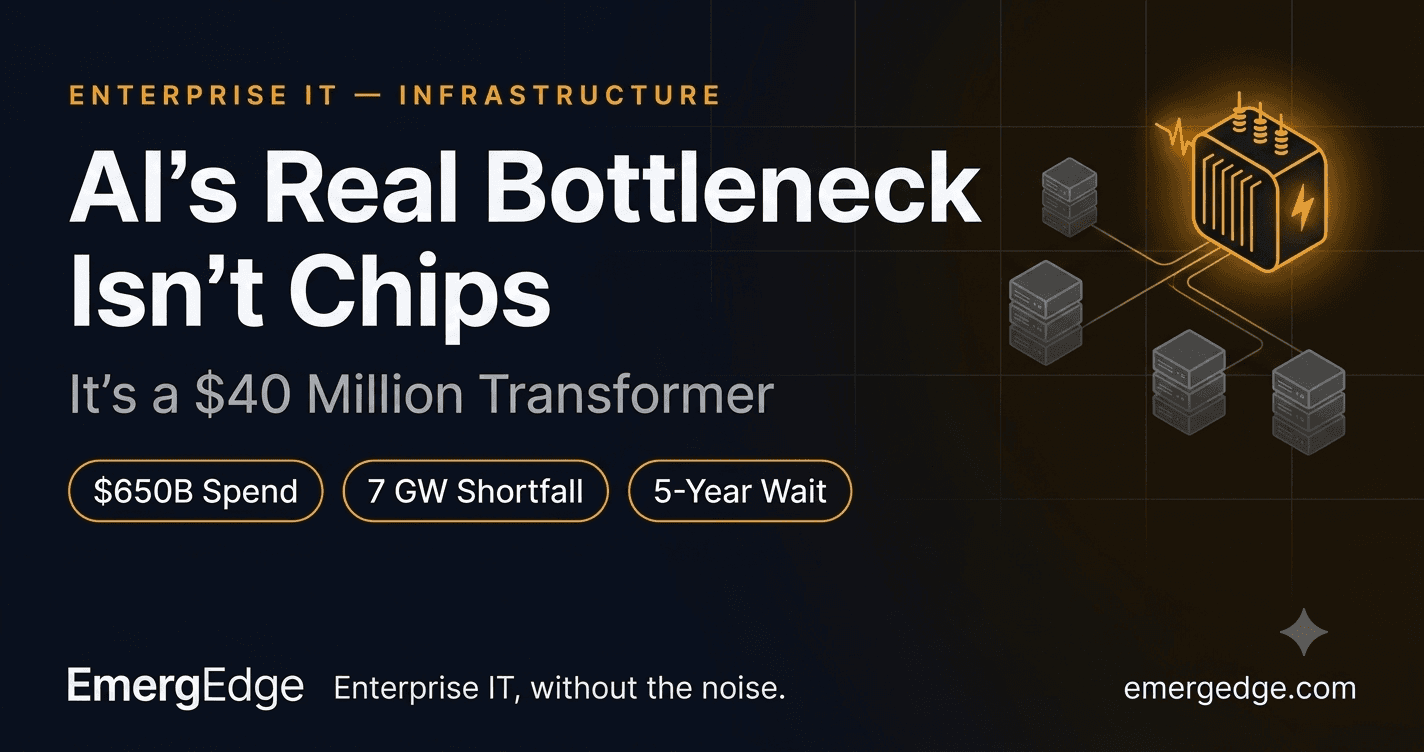
Alphabet, Amazon, Meta, and Microsoft remain on track to spend more than $650 billion combined on AI infrastructure in 2026 — a figure that has not moved despite the shortfall. The capital is fully committed. The physical equipment needed to turn that capital into energised megawatts is not arriving on schedule, and in some cases will not arrive for years.
The Component Nobody Budgets For
Transformers, switchgear, and battery systems — the unglamorous backbone of any large power delivery system — represent less than 10% of total data centre construction cost. They are currently responsible for effectively 100% of the delay across the industry's biggest buildout in history.
The asymmetry is stark: a modern AI data centre can be built in under 18 months once the components are available. The high-voltage transformers required to power it can now take up to five years to deliver, stretched from a pre-2020 baseline of 12 to 18 months. A $2 billion campus — shell built, cooling installed, racks ready — can sit fully idle waiting on a single $40 million transformer order. Capital cannot outrun physics, and it turns out physics runs through a handful of transformer manufacturers, most of them outside the United States, now facing tariff-driven cost increases of 15% to 25% on top of already-stretched lead times.
This is the part every IT leader planning infrastructure around AI in 2026 needs to sit with: the bottleneck is not the part of the budget anyone was watching.
The Grid Was Never Built for This
A single large-scale AI training facility can draw 100 to 300 megawatts — the consumption profile of a small city, running continuously rather than fluctuating like typical urban demand. When several of these facilities cluster in the same region, chasing the same fibre routes and land availability, cumulative demand overwhelms local grid capacity in ways the grid was never designed to absorb.
The numbers are moving fast. Data centres are projected to rise from roughly 4% of total U.S. electricity demand in 2023 to as much as 12% by 2028. Globally, data centre electricity consumption is on track to roughly double between 2024 and 2028. Grid interconnection queues — the process of actually getting a new facility connected to the power grid — now average four to seven years in markets like Northern Virginia, Phoenix, and Dallas, the exact regions where hyperscalers most want to build.
The result is an 18-month-versus-five-year asymmetry: the building goes up fast, and then waits.
How Big Tech Is Responding — Becoming Utilities
Faced with a queue measured in years, Microsoft, Amazon, and Google are increasingly bypassing public utilities altogether. All three have signed direct, multi-decade power purchase agreements to restart shuttered nuclear plants and are collectively bankrolling small modular reactor (SMR) development with more than $10 billion in committed capital. Conditional offtake agreements for SMR capacity have grown from roughly 25 gigawatts to 45 gigawatts in under two years, with developers like NuScale, Oklo, Kairos Power, and X-Energy racing toward deployment by the early 2030s.
This is a genuinely strange position for a software company to be in. The organisations that built their advantage on infinitely elastic cloud compute are now, functionally, becoming electric utility operators and nuclear plant financiers — because the compute layer stopped being the constraint years before the power layer did.
Behind-the-meter gas generation and dedicated onsite renewables round out the near-term response, but at current build rates they remain a small fraction of 2026's actual pipeline. Nuclear, in whatever form, is the only response with the scale to matter — and it will not arrive fast enough to close the 2026 to 2028 gap.
What This Means Beyond the Hyperscalers
If you have read the rest of the datacenter coverage on this site — the shift to liquid cooling, the harmonic filtering that protects sensitive power quality, the flywheel-versus-battery UPS trade-off, the debate over on-prem versus cloud under extreme AI load — this power crisis is the macro story that makes every one of those micro-decisions higher stakes than they were two years ago.
Every enterprise IT leader evaluating an on-prem AI buildout, a colocation contract, or even an aggressive cloud AI roadmap should treat power availability, not compute pricing, as the primary planning constraint for 2026 through 2028. Colocation providers with existing grid interconnection are becoming pricing-makers rather than pricing-takers. Enterprises planning their own AI infrastructure without a secured power position are effectively queuing behind the same five-year wait as the hyperscalers, just without the balance sheet to fund a nuclear plant while they wait.
What to Do Next
Three questions worth asking before finalising any AI infrastructure plan this year:
1. Have you asked your colocation or cloud provider specifically about their power interconnection position — not just their compute capacity? A provider with abundant GPUs but a queued grid connection is promising capacity it cannot actually energise on your timeline.
2. If your organisation is planning on-prem AI infrastructure, have you priced the transformer and switchgear lead time into your project timeline, or only the construction schedule? The 18-month build and the up-to-five-year power delivery are two different clocks, and treating them as one is how projects quietly slip by years.
3. Does your infrastructure roadmap assume compute is the scarce resource, or has it caught up to the reality that power now is? The organisations planning around the old assumption are going to be surprised by the same wall the hyperscalers just hit — just without $650 billion to absorb the shock.
Sources: Bloomberg, Sightline Climate, International Energy Agency, Tom's Hardware.