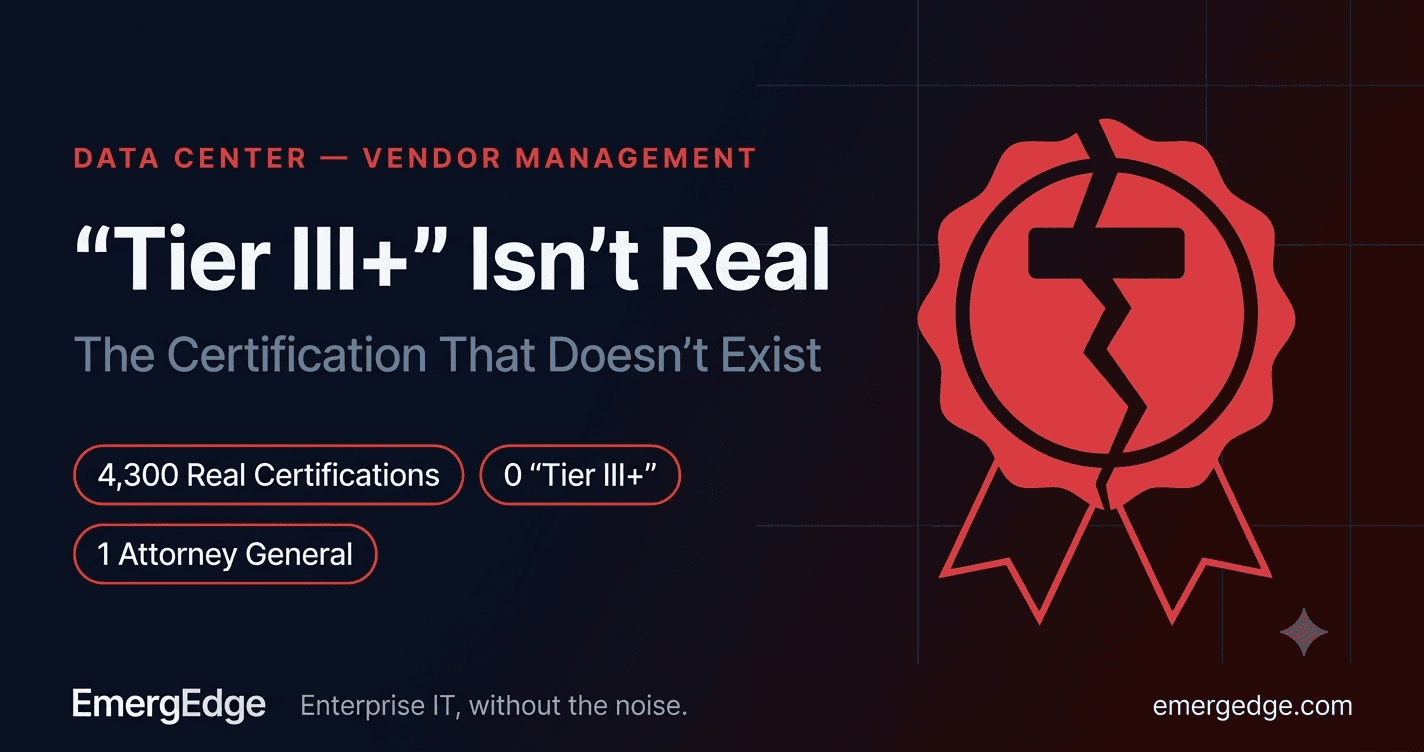
Search "Tier III+ data center" and you will find dozens of colocation providers advertising it — alongside "Tier IV-ready," "Tier III equivalent," and "near-Tier IV." All of it sounds authoritative. All of it borrows the credibility of a real, rigorous certification system. None of it is real.
Uptime Institute — the only body that actually certifies data centre tiers — recognises exactly four classifications: Tier I, Tier II, Tier III, and Tier IV. No plus. No minus. No "ready." A facility either meets the requirements of a tier, verified by independent audit, or it doesn't. There is no partial credit and no official in-between category.
In 2015, the gap between that marketing language and certified fact got serious enough that a state Attorney General's office got involved. This is the story of what tier certification actually verifies, how an entire industry built a vocabulary around pretending otherwise, and what it should have taught every enterprise IT leader who has since signed a colocation contract based on a sales deck instead of a certificate number.
What Tier Certification Actually Verifies
Uptime Institute's Tier Standard rates facilities on redundancy and fault tolerance across four levels. Tier I is basic capacity with no redundancy. Tier II adds redundant components. Tier III requires concurrent maintainability — every component can be taken offline for maintenance without disrupting operations, achieved through N+1 redundancy. Tier IV requires fault tolerance — the facility can withstand an unplanned failure of any single component with zero disruption, which in practice means 2N or better redundancy across every system, not just the ones a provider chooses to invest in.
Critically, certification is a two-stage, independently audited process, not a self-assessment. A Tier Certification of Design Documents (TCDD) verifies that engineering drawings meet a tier's requirements on paper. A separate Tier Certification of Constructed Facility (TCCF) verifies, after a physical site audit, that what was actually built matches what was designed. A facility can pass the first and never pursue the second — meaning it was designed to a tier standard but never proven to have been built to it.
Since the standard was introduced, Uptime Institute has issued more than 4,300 certifications across over 120 countries. That number matters because of how small it is relative to the global data centre market — tens of thousands of facilities operate worldwide, the overwhelming majority of which have never gone through this process at all.
Where "Tier III+" Actually Comes From
No engineering committee invented "Tier III+." It emerged the way most marketing categories do: providers wanted to signal "better than Tier III" without paying for what Tier IV actually costs.
Tier IV certification typically costs roughly double the capital investment of Tier III, because full fault tolerance means duplicating every redundant path, not just the ones that fail most often. For most colocation providers, the economics don't work — enterprise customers are rarely willing to pay the premium required to justify true 2N infrastructure across an entire facility. So instead of building to Tier IV and certifying it, providers add select Tier IV characteristics to a Tier III facility — 2N power on part of the critical path, for instance — and market the result as "Tier III+" or "Tier IV-ready."
This isn't necessarily dishonest engineering. A facility genuinely can be "Tier III-like" with real, meaningful redundancy improvements over a baseline Tier III design. The dishonesty starts when that language is used to imply independent verification that was never sought — when "Tier III+" is presented to a customer signing a seven-figure colocation contract as though it carries the same evidentiary weight as an actual Uptime certificate.
The Case That Made This Concrete: ViaWest, Las Vegas
In the mid-2010s, colocation provider ViaWest advertised its Las Vegas facility as a Tier IV data centre. The reality, once examined closely, was more complicated.
The design documents for Phase I of the facility had been certified by Uptime Institute as meeting Tier IV — but the constructed facility itself was never certified. Design certification and constructed-facility certification are not the same claim, and ViaWest's marketing did not make that distinction clear to customers. Phase II of the same facility, meanwhile, held certifications for both design and constructed facility — but at Tier III, not Tier IV.
A customer complaint reached the Nevada Attorney General's office, which sent ViaWest a letter indicating the company's marketing may have violated the state's Deceptive Trade Act. Uptime Institute itself weighed in publicly, describing this kind of misaligned tier marketing as "recklessly misleading to the industry" — and changed its own certification rules as a direct consequence, adding an expiration date to Design Certifications so that a "certified" claim based on paper drawings from years earlier could no longer be marketed indefinitely as equivalent to a verified, operating facility.
That is what happens when the gap between marketing language and certified fact gets examined by someone with the authority to ask hard questions. Most enterprise procurement teams evaluating a colocation contract never ask those questions at all.
Why This Should Matter to Every Enterprise IT Leader, Not Just Procurement Lawyers
This is not an argument that every provider using "Tier III+" language is being deceptive. Many are describing genuinely well-engineered facilities accurately, in the only vocabulary the market has normalised. The argument is narrower and more practical: that language, by itself, tells you nothing verifiable, and treating it as though it does is a due-diligence failure with real financial consequences.
An enterprise signing a colocation or managed hosting contract based on tier language it never independently verified is making an SLA and business-continuity decision on the strength of a sales deck. If that facility experiences an outage that a genuinely certified equivalent would have withstood, the gap between what was promised and what was verified becomes the enterprise's operational problem — not the provider's marketing problem.
This connects directly to the broader pattern every IT leader evaluating infrastructure should already be applying: verify the specific, checkable claim, not the impressive-sounding adjacent one. It is the same discipline this site has argued for when evaluating a provider's power interconnection position rather than its GPU inventory — ask for the artifact that can actually be checked, not the term that sounds like it.
What to Actually Ask Before You Sign
1. Ask for the certificate number, not the tier name. A genuinely certified facility can give you a certificate number you can independently verify against Uptime Institute's own records. "We're built to Tier III+ standards" with no certificate number is not evidence — it is a claim.
2. Ask whether the certification covers the design or the constructed facility — and when it was issued. A Design Certification proves intent, not outcome, and (since the ViaWest case) now has an expiration date for exactly this reason. Only a Constructed Facility certification proves what was actually built matches what was promised.
3. Ask what specifically earns the "+". If a provider uses "Tier III+" language, ask them to name the exact components that received Tier IV-equivalent treatment, and which didn't. A vague answer is itself the answer.
The Bottom Line
A tier rating you cannot independently verify is not a rating. It is a sales pitch borrowing the vocabulary of an engineering standard it was never audited against.
Uptime Institute built a genuinely rigorous, two-stage, independently audited certification system precisely because "we're basically Tier IV" is not a claim any serious infrastructure decision should be made on. The industry's response was to build a marketing vocabulary that sounds identical to that rigor while carrying none of its verification. Most enterprises signing colocation contracts have never asked the one question that collapses the difference: can you show me the certificate number?
If the answer is no, you are not evaluating a tier. You are evaluating a sentence someone in marketing wrote.