In November 2023, Broadcom completed its $61 billion acquisition of VMware — the largest enterprise software deal in history at the time. The technology press was divided. Some called it a masterclass in strategic acquisition. Others called it an overpay for a company selling software that virtualisation had already been commoditised by cloud platforms, containers, and Kubernetes.
Two years later, it is clear which camp was right.
Broadcom's acquisition of VMware was not a bet on virtualisation technology. It was a bet on lock-in — the most powerful and the most underestimated force in enterprise IT economics. And every organisation running VMware workloads is now living the consequences of that bet, whether they were paying attention to the acquisition or not.
What VMware Actually Was
Before understanding what Broadcom bought, it is worth understanding what VMware had built over the preceding twenty-five years.
VMware invented enterprise server virtualisation as a commercial product in the early 2000s. The concept — running multiple virtual machines on a single physical server — transformed enterprise infrastructure economics overnight. Instead of one application per server, organisations could run dozens. Server utilisation rates that averaged 10–15% shot up. Hardware costs fell. Data centre footprints shrank.
By the mid-2010s, VMware's vSphere platform was the foundation of virtually every enterprise data centre globally. Not some enterprises. Not most enterprises. Virtually every enterprise above a certain size ran VMware. Its market penetration was, and remains, extraordinary.
The product portfolio expanded aggressively: vSphere for server virtualisation, vSAN for software-defined storage, NSX for network virtualisation, vRealize for cloud management, Horizon for virtual desktop infrastructure, Carbon Black for security. Each product deepened the integration between VMware components and made replacing any single piece progressively more disruptive.
This is the asset Broadcom acquired. Not primarily a technology asset. A lock-in asset — a platform so deeply embedded in enterprise infrastructure that replacing it is a multi-year, multi-million-dollar undertaking that most organisations will defer as long as possible.
Why Broadcom Paid $61 Billion
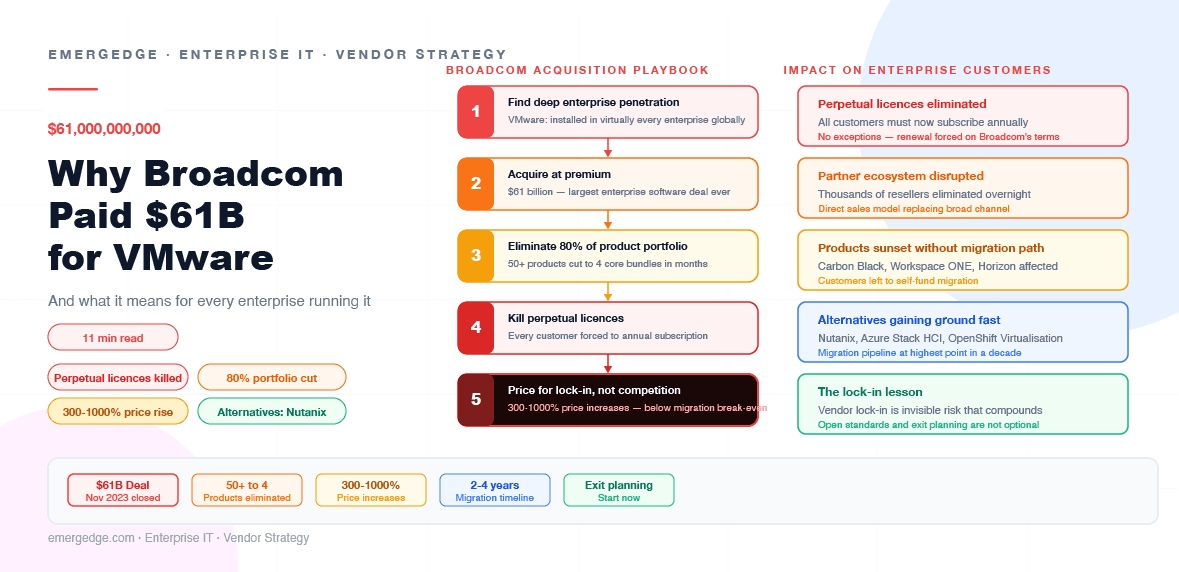
Broadcom's CEO Hock Tan has executed the same acquisition playbook repeatedly and profitably across the semiconductor and enterprise software industries. The playbook has five steps:
Step 1 — Identify a product with deep enterprise penetration and high switching costs. VMware qualified perfectly. Two decades of infrastructure built on vSphere cannot be migrated in months.
Step 2 — Acquire the company. $61 billion, financed partly with debt, representing a significant premium to VMware's trading price before the deal.
Step 3 — Eliminate unprofitable product lines aggressively. Broadcom cut VMware's product portfolio from over 50 products to approximately 4 core bundles within months of closing. Products discontinued or sunset included Carbon Black, while Workspace ONE and Horizon were spun off as Omnissa — an independent company with no relation to Broadcom, vRealize Operations, and dozens of others that VMware had built or acquired over the years.
Step 4 — Kill perpetual licences, mandate subscription. This is the critical economic transformation. A perpetual licence is a one-time revenue event. A subscription is a recurring annual revenue stream that compounds. Broadcom eliminated perpetual licences entirely — every customer must now subscribe to VMware Cloud Foundation (VCF) or one of a small number of approved bundles.
Step 5 — Price for lock-in, not for competition. When customers cannot easily leave, competitive pricing pressure disappears. Broadcom raised prices dramatically — reports from enterprise customers indicate increases of 300% to 1000% on comparable functionality compared to their previous VMware agreements.
The result: Broadcom acquired a company generating approximately $4 billion in annual operating profit and is targeting significantly higher margins through subscription conversion and portfolio rationalisation.
What Changed for Enterprise Customers — Immediately
The changes Broadcom implemented affected enterprise VMware customers almost immediately after deal close.
Perpetual licences: eliminated. Organisations that had purchased perpetual vSphere, vSAN, or NSX licences — and planned to amortise that investment over a decade — were informed that support and updates would continue only if they transitioned to subscription agreements. The perpetual licence model that most enterprise procurement processes were designed around ceased to exist.
Support contracts: restructured. Broadcom discontinued VMware's previous support tiers and replaced them with a unified support model bundled into the subscription packages. Organisations that had separate support agreements outside their licence structure found those agreements discontinued.
Partner ecosystem: disrupted. VMware had built one of the largest partner ecosystems in enterprise software — thousands of resellers, system integrators, and managed service providers. Broadcom dramatically reduced the number of authorised partners, eliminating tens of thousands of reseller relationships and centralising sales through a smaller, direct-focused channel.
Product continuity: uncertain. The rapid elimination of products that VMware customers had been using — and in some cases building business processes around — created significant operational uncertainty. Customers running Carbon Black for endpoint security or Workspace ONE for endpoint management were informed those products were being sunset and needed to migrate.
The Lock-In Calculus
The reason Broadcom could make these changes without immediately losing the majority of its customer base comes down to the economics of switching from VMware.
An enterprise organisation that has operated a VMware-based infrastructure for ten or fifteen years has typically built that infrastructure across hundreds or thousands of servers. Virtual machine templates, networking configurations, storage policies, backup integrations, monitoring systems, automation scripts, and operational runbooks are all designed around VMware-specific tooling and APIs.
Migrating that infrastructure to an alternative — whether Microsoft Hyper-V, Nutanix, Red Hat OpenShift virtualisation, or a public cloud platform — is not a technical exercise. It is a multi-year programme requiring:
- Full inventory and dependency mapping of every running workload
- Re-creation of networking and storage configurations on the alternative platform
- Re-training of infrastructure, operations, and development teams
- Parallel running of old and new environments during migration
- Testing and validation of every migrated workload
- Update of all operational processes, monitoring, and automation tooling
For a large enterprise, this programme typically costs tens of millions of pounds and takes two to four years to complete safely. During that time, the organisation continues to pay VMware subscription fees. The economics of migration frequently do not make sense compared to paying the increased subscription cost — at least in the short term.
This is exactly the calculus Broadcom modelled. They know the switching cost. The pricing increase is calibrated to stay below the point where migration becomes economically preferable to renewal — but well above what VMware charged before the acquisition.
What Alternatives Actually Exist
The discomfort of the situation is forcing enterprise IT leaders to evaluate alternatives more seriously than at any point in the past decade. The realistic options vary significantly by workload type and strategic direction.
Microsoft Hyper-V and Azure Stack HCI. For organisations already deeply committed to the Microsoft ecosystem — Windows Server, Active Directory, Azure — Microsoft's virtualisation stack is the most natural transition. Azure Stack HCI in particular provides a converged infrastructure platform that integrates tightly with Azure for hybrid cloud scenarios. The operational model is different from vSphere, and the migration is non-trivial, but the long-term strategic alignment with Microsoft's broader platform is compelling for Microsoft-centric organisations.
Nutanix. Nutanix has positioned itself aggressively as the primary VMware alternative and has seen significant pipeline growth since the Broadcom acquisition. The Nutanix Cloud Infrastructure platform provides hyperconverged infrastructure with its own AHV hypervisor that is included at no additional cost. For organisations looking for the closest operational equivalent to the VMware stack — with similar management interfaces and operational patterns — Nutanix is the most direct replacement.
Red Hat OpenShift Virtualisation. For organisations already investing in Kubernetes and container-based workloads, OpenShift Virtualisation provides the ability to run virtual machines alongside containers on the same platform. This is strategically compelling for organisations whose application modernisation roadmap is moving workloads from VMs to containers over time — it provides a single platform that spans both.
Public cloud migration. For workloads that do not require on-premises residency, VMware migrations have accelerated the business case for public cloud migration. AWS, Azure, and Google Cloud all provide migration tooling and managed services that can absorb VMware workloads. The economic comparison between continued VMware subscription costs and cloud hosting is now tighter than it was before the pricing changes.
The Vendor Lock-In Lesson
Project Natick taught a lesson about innovation — that a successful pilot does not guarantee a viable product. The VMware situation teaches a different lesson, equally important for every IT leader: vendor lock-in is not a technical problem. It is a strategic risk that compounds invisibly over years until an event like an acquisition makes the exposure visible overnight.
Most organisations did not plan to be locked into VMware. They chose VMware because it was the best product at the time, and because every subsequent infrastructure decision naturally built upon the previous one. The lock-in was not a trap they fell into — it was the natural result of good technical decisions made in isolation, without a governance framework that tracked strategic exposure to single vendors.
The questions every IT leader should ask right now — not just about VMware, but about every significant vendor in their portfolio:
1. What would it cost us to replace this vendor today? Not conceptually — what would it actually cost in time, money, and business disruption? If you cannot answer this question for your top ten technology dependencies, you do not understand your strategic risk profile.
2. What percentage of our infrastructure, data, and processes are dependent on proprietary interfaces that a single vendor controls? Open standards — open APIs, open data formats, open protocols — preserve optionality. Proprietary interfaces erode it.
3. Is our vendor relationship structured to benefit us or to benefit the vendor? Long-term contracts, large upfront commitments, and deep technical integration all benefit vendors. Multi-year exit plans, data portability requirements, and contract terms that include migration assistance preserve your negotiating position.
What to Do If You Are Running VMware Right Now
Audit your exposure. Map every VMware product in use, the workloads dependent on each, and the contract terms and renewal dates. This baseline does not exist in most organisations — build it.
Model the full cost of staying vs leaving. The full cost of staying includes not just licence and support fees but the strategic premium of reduced negotiating leverage over a five to ten year horizon. The full cost of leaving includes migration costs, productivity impact, and parallel running costs. Neither is simple — both are necessary.
Engage Broadcom directly before renewal. The most significant price increases have been imposed on customers who did not negotiate proactively. Broadcom's direct sales team has shown willingness to negotiate for customers who engage early with a credible alternative evaluation in progress.
Start a parallel alternative evaluation now. Even if you are not planning to migrate, a credible evaluation of Nutanix, Azure Stack HCI, or another alternative changes your negotiating position with Broadcom. Procurement leverage requires a credible alternative — you cannot negotiate effectively from a position of acknowledged lock-in.
Build a three-year exit capability. Even if you do not exercise it, building the internal capability to migrate workloads off VMware over a three-year horizon — through skills development, architecture decisions that reduce proprietary dependencies, and pilot migrations of suitable workloads — gives you strategic optionality that you currently do not have.
The Bottom Line
Broadcom paid $61 billion for VMware because enterprise lock-in at scale is one of the most valuable assets in technology. The product is not the asset. The switching cost is the asset.
For enterprise IT leaders, the VMware situation is the most important vendor management case study of the decade — not because of what Broadcom did, but because of what it reveals about how organisations accumulate strategic risk invisibly over years of individually rational technology decisions.
The lesson from Project Natick was that even successful technology does not always make it to production. The lesson from VMware is harder: technology that makes it to production, at scale, across your entire infrastructure, can become your biggest strategic liability the moment the company behind it changes its priorities.
Vendor diversification, open standards, and exit planning are not bureaucratic overhead. They are the disciplines that preserve your organisation's strategic freedom.