Who owns the backup power chain in your organisation: one team, or four?
Most organisations can say they have a UPS, a generator and a fuel contract. Fewer can say who owns the whole chain: the utility feed, the transfer switch, the batteries, the generators, the fuel and the procedure that ties them together. That gap matters, because Uptime Institute's 2026 outage analysis shows where the failures concentrate.
What the data says
Uptime Institute released its eighth annual outage analysis in May 2026. Three findings matter for anyone responsible for backup power.
Power remains the leading cause of impactful outages. Uptime reports that failures involving UPS systems, transfer switches and generators are dominant. Put differently, the equipment designed to protect against a power problem is also where many of the serious failures start.
The risks are changing. Uptime says worsening grid constraints and high-density workloads are introducing new pressure points. The utility feed is less of a given, and equipment is being asked to run closer to its limits.
Outages are getting more expensive. In Uptime's 2025 annual survey, one in five respondents reported that their most recent major outage cost more than $1 million, for the second consecutive year. Overall, outage rates per site have declined for the fifth consecutive year, but Uptime notes the pace of improvement has slowed.
Two further points from the report are worth noting. Failures to follow established procedures remain the leading driver of human-error-related outages. And Uptime observes that resiliency assessments remain more focused on internal systems than on external and systemic risks.
The backup chain is only as strong as its weakest link
A generator that starts perfectly in a test does nothing if the transfer switch does not move the load. A UPS with healthy batteries does not help if the batteries are the source of a fire. A full fuel tank does not help if nobody follows the procedure at 3 a.m.
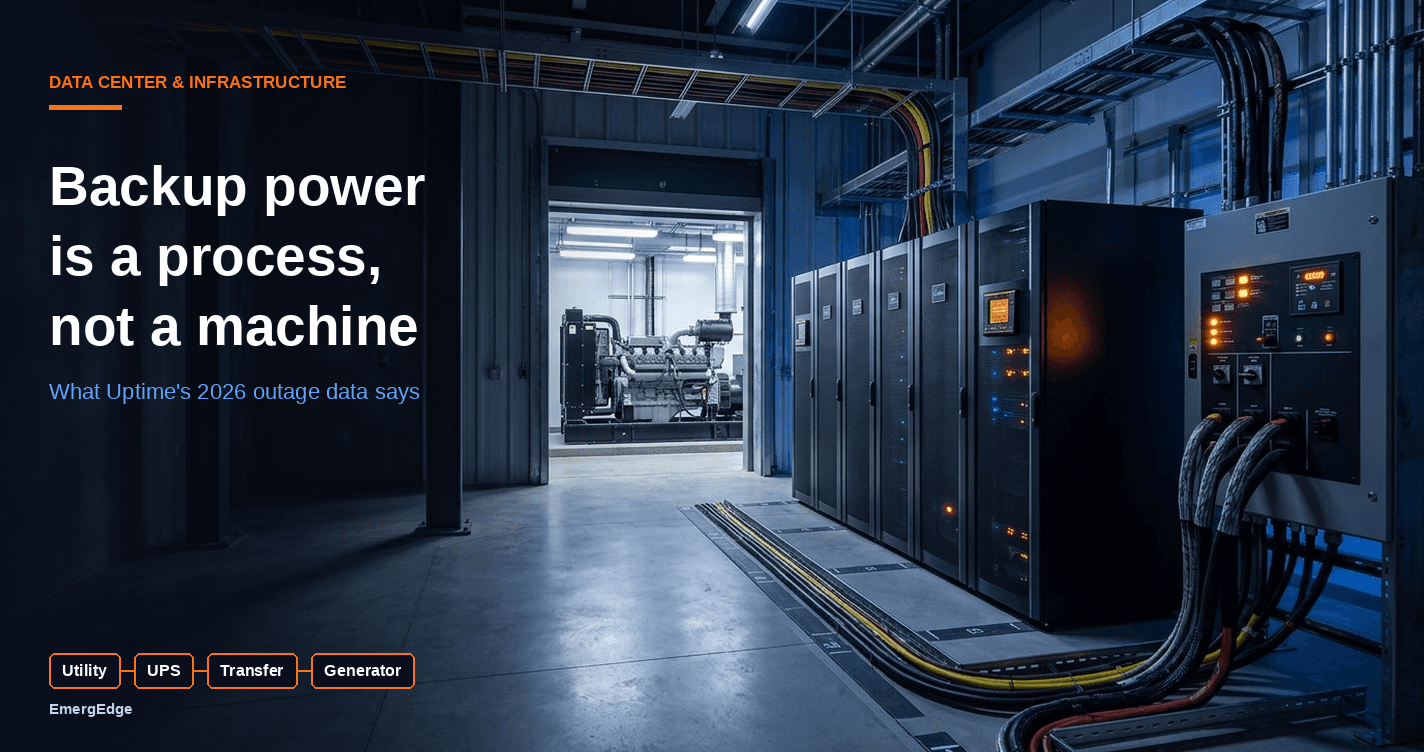
This is why backup power is a process and not a machine. The equipment matters, but outages tend to occur at the points where equipment, people and procedures meet: the handover from utility to battery to generator and back again.
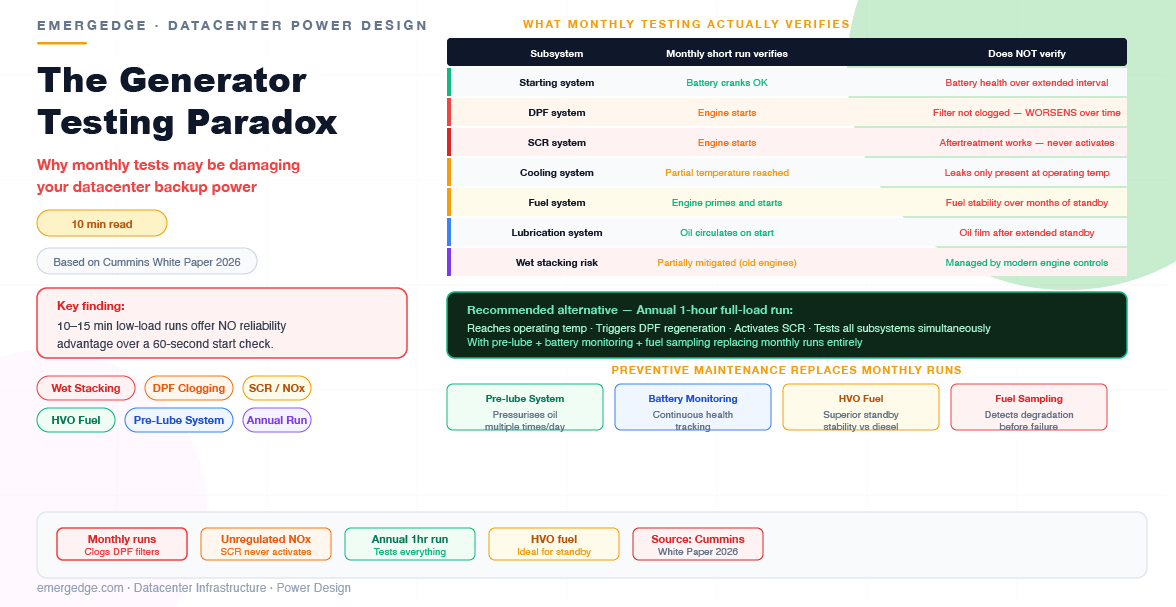
Earlier on EmergEdge, we looked at one example of this thinking: the generator testing paradox, where frequent, low-load test runs can give false comfort while causing wear. The wider lesson is the same. Testing the machine is not the same as testing the chain.
An illustrative example
The following is a composite scenario, not a description of any one organisation.
An enterprise runs monthly generator tests and records a pass every time. During a real utility disturbance, the generator starts, but the load does not transfer cleanly, and a section of the facility goes down. The post-incident review finds that the monthly test started the generator but did not exercise the transfer under real load. It also finds that the procedure for manual transfer existed, but the shift on duty had never rehearsed it.
Nothing in the equipment was unusual. The weak point was that no one owned the chain from end to end, and the test measured the machine instead of the process.
Five questions about your own backup strategy
1. Do our tests exercise the whole chain, or only the generator? Include the transfer switch, the UPS behaviour and the return to utility. Where it is safe to do so, test under realistic load.
2. Who owns the chain end to end? Facilities, IT, electrical contractors and vendors each hold a part. Name one accountable owner for the complete path.
3. Can we replace critical equipment quickly? Uptime's report notes that shortages of equipment such as transformers, generators, switchgear and UPS systems have pushed some operators towards substitute or secondhand components, which it believes have contributed to some failures. Know your lead times, your spares, and your vendor response commitments before you need them.
4. Do our people drill the emergency procedure? Uptime highlights failure to follow procedures as the leading driver of human-error outages and recommends simplified procedures and routine drills. A procedure nobody has rehearsed is a document.
5. What do we assume about the grid and other external dependencies? Uptime points to worsening grid constraints and to risks that sit outside the building. Write down what happens if the utility feed is unreliable for longer than your design assumes, and who decides what to shed.
What this means for IT leaders
Backup power is easy to treat as a facilities topic that only matters during an incident. The data says the opposite: power is where the serious failures concentrate, the cost of a major outage is rising, and improvements are harder to find. The organisations that do well are not the ones with the newest equipment. They are the ones that treat the backup chain as a process with one owner, a tested path and a rehearsed procedure.
The question to take away: if the utility feed failed tonight, which part of your chain has never been tested together?
Sources: Uptime Institute, "Uptime Announces Annual Outage Analysis Report 2026" (press release, May 13, 2026); Network World, "Network outages, power failures strain data center resiliency" (May 14, 2026), reporting on Uptime's outage analysis and webinar.