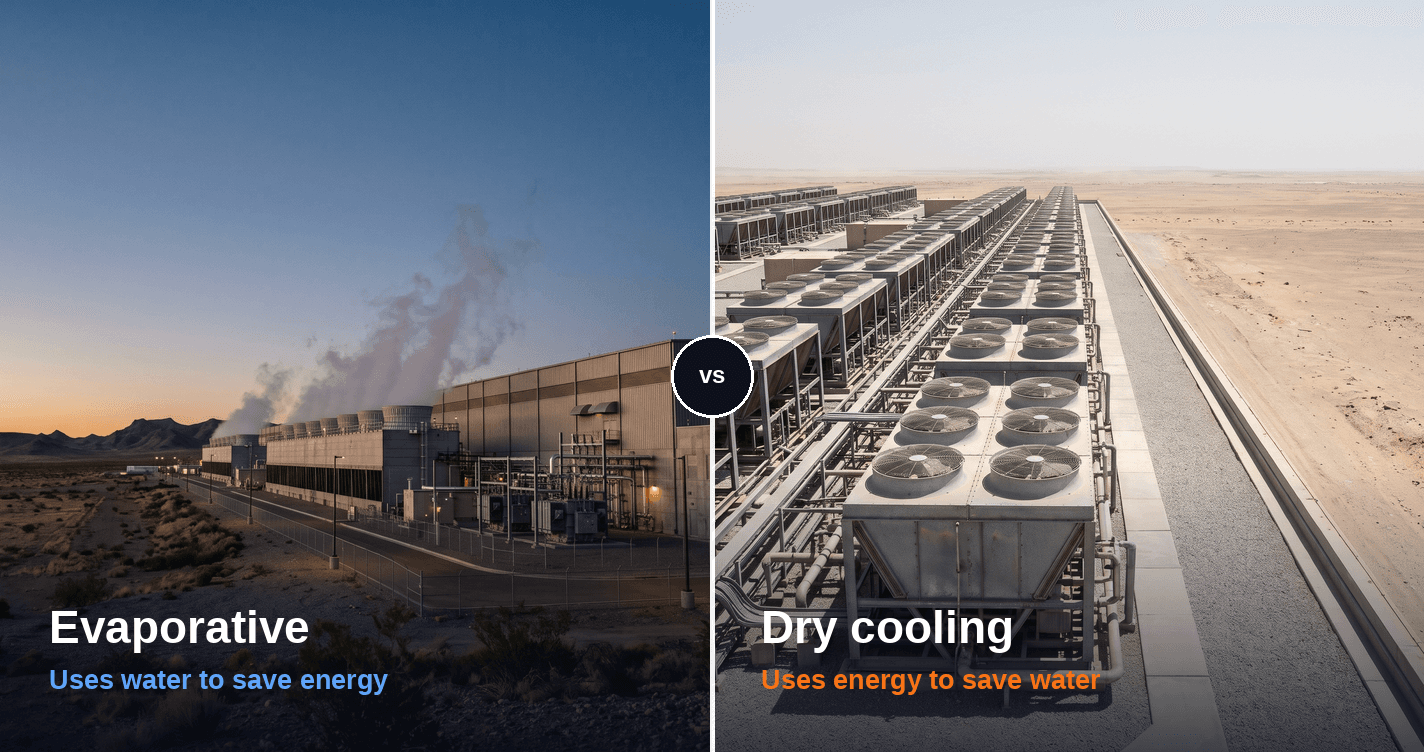
Does your data center save energy by using water, or save water by using energy?
You cannot optimise both at once. That is the cooling trade-off, and it matters more every year as racks get denser and the climate in which facilities operate gets less forgiving. It is also a trade-off that many organisations discover late, when a design has already been approved and a permit, a utility bill or an auditor raises the question nobody asked at the start.
Two metrics, one trade-off
Two measures describe the cooling problem.
PUE (Power Usage Effectiveness) is the total energy a facility uses divided by the energy used by the IT equipment itself. A PUE of 1.5 means that for every unit of energy the servers use, another half unit goes to cooling, power conversion and everything else. Lower is better.
WUE (Water Usage Effectiveness), introduced by The Green Grid in 2011, is the water a site consumes in a year divided by the energy its IT equipment uses, expressed in litres per kilowatt-hour. It is much less widely tracked than PUE.
The reason you need both is that a design can improve one by worsening the other. Evaporative cooling rejects heat by evaporating water. It is usually energy-efficient, because evaporation removes heat cheaply, but it consumes water. Dry cooling rejects heat to the air through coils and fans. It uses little or no water, but in a hot climate it generally needs more energy to do the same job, particularly on the hottest days when the temperature difference to work with is smallest.
Neither option is "green" by default. Each moves the cost from one meter to another. The design that looks best on a PUE chart can be the one that is hardest to defend in a water-scarce region, and the reverse is also true.
What the survey data says
Uptime Institute's 15th Annual Global Data Center Survey, published in July 2025 with responses from more than 800 owners and operators, reports three things relevant here.
First, average PUE has shown little change for the sixth consecutive year. Uptime attributes the plateau to legacy infrastructure and to climate-specific limits on efficient cooling. In other words, the easy gains were taken years ago, and the remaining gains are expensive, site-specific or constrained by location.
Second, rack densities keep rising, with greater adoption of racks in the 10 to 30 kW range. Few facilities exceed 30 kW, and extreme densities are still rare. But the direction is clear, and more heat per rack puts more pressure on whichever cooling approach you chose.
Third, sustainability reporting has not improved. Uptime notes that the collection and reporting of key sustainability metrics did not get better in 2025, partly because of commercial pressure to support AI workloads and easing regulatory pressure in some regions.
Water shows the reporting gap most clearly. In Uptime's 2021 survey, reported by Computer Weekly, only about half of operators said they tracked the water their facilities use for cooling, and those who did often tracked it site by site rather than across a portfolio. Among the operators who did not track water, 63% said there was "no business justification" and 23% said they lacked the technical capability. This data is five years old, and practice may have moved since. But the 2025 finding that sustainability reporting has not improved suggests the gap has not closed.
Why the missing water number is a risk
If you do not measure water, you cannot defend your design when someone asks about it. And people are asking. Uptime stated in the same report that a growing number of municipalities will permit new data center developments only if they are designed for minimal or near-zero direct water consumption, and that such rules will heavily influence facility design and product choices.
That has a practical consequence for a design review. A cooling system chosen purely on energy efficiency can later face a constraint it was never designed for: a restricted supply, a permit condition, a tariff change or a reporting requirement. Retrofitting cooling is among the most expensive changes a facility can make, because it affects the building, the power and the live load at the same time.
An illustrative example
The following is a composite scenario, not a description of any single organisation.
An enterprise plans an expansion of its main data hall. The design review compares two cooling options. Option A uses evaporative cooling and shows a clearly better PUE. Option B uses a dry system with a higher projected energy use. The review picks A, because the energy saving is the number in the business case.
Two years later, the site's local water authority introduces a restriction on industrial consumption during summer months, and the facilities team discovers that nobody has been tracking water use per unit of IT energy. They cannot say how much the new hall uses, how it compares with the old one, or how it would behave under a cap. The conversation that should have happened at the design stage happens during an incident.
Nothing in this scenario is a technology failure. The design met its requirement. The requirement was incomplete.
Liquid cooling does not remove the question
As rack densities increase, many operators look to liquid cooling, where a liquid carries heat away from the hardware more efficiently than air. It is an important development and is likely to matter more over time. But it changes where heat is captured, not whether it must be rejected. The heat still has to go somewhere, and the method used to reject it, whether through evaporation or dry coolers, brings back the same trade-off between energy and water. A liquid-cooled design should be assessed against the same two meters.
Four questions to ask before you choose or renew a cooling design
- What are our PUE and our water use per unit of IT energy, and do we measure both? If you only measure one, you do not yet know the trade-off you are making.
- How does the design behave on our hottest days, not on the annual average? Peak conditions are where energy and water demand both rise, and where capacity limits appear.
- Where does the water come from, and what happens if the supply is restricted? Know the source, the contract, the permit conditions and the fallback.
- What does the design assume about future rack density? A system sized for today's load may not be the one you want when AI workloads arrive.
A fifth question sits under all four: who owns the answer? Facilities, IT, sustainability and finance each hold part of this decision. If nobody owns the trade-off, it will be made by default, by whichever number appears in the business case.
What this means for IT leaders
Cooling is often treated as a facilities topic, but it determines how much capacity you can add, what it costs to run, and whether the site can operate under future constraints. For organisations in hot, water-scarce regions, it is a design decision to make early and to review regularly, not a sustainability line in the annual report.
The best cooling design is not the one with the lowest PUE or the lowest water use. It is the one whose trade-off you have measured, understood and chosen on purpose.
Sources: Uptime Institute, "Global Data Center Survey 2025" (press release, July 30, 2025), Computer Weekly, "Uptime Institute highlights patchy reporting of water use by datacentre operators" (reporting on Uptime's 2021 survey).