Every enterprise platform runs on a vendor clock. Support windows close, licence models change and product lines are retired. The clock is easy to ignore until a date appears on a calendar.
SAP offers a clear public example. It will provide mainstream maintenance for its Business Suite 7 core applications, which include SAP ERP 6.0 and SAP CRM 7.0, until the end of 2027. Customers who need more time can choose optional extended maintenance from 2028 to the end of 2030, at a premium of two percentage points on the maintenance basis. Customers who do not opt in, or whose extended maintenance has ended, receive what SAP calls customer-specific maintenance. Other vendors have their own versions of this clock.
A date like that forces a decision. Whether it is a good decision depends on something that has little to do with the platform: governance.
Two Systems of Record, Two Different Jobs
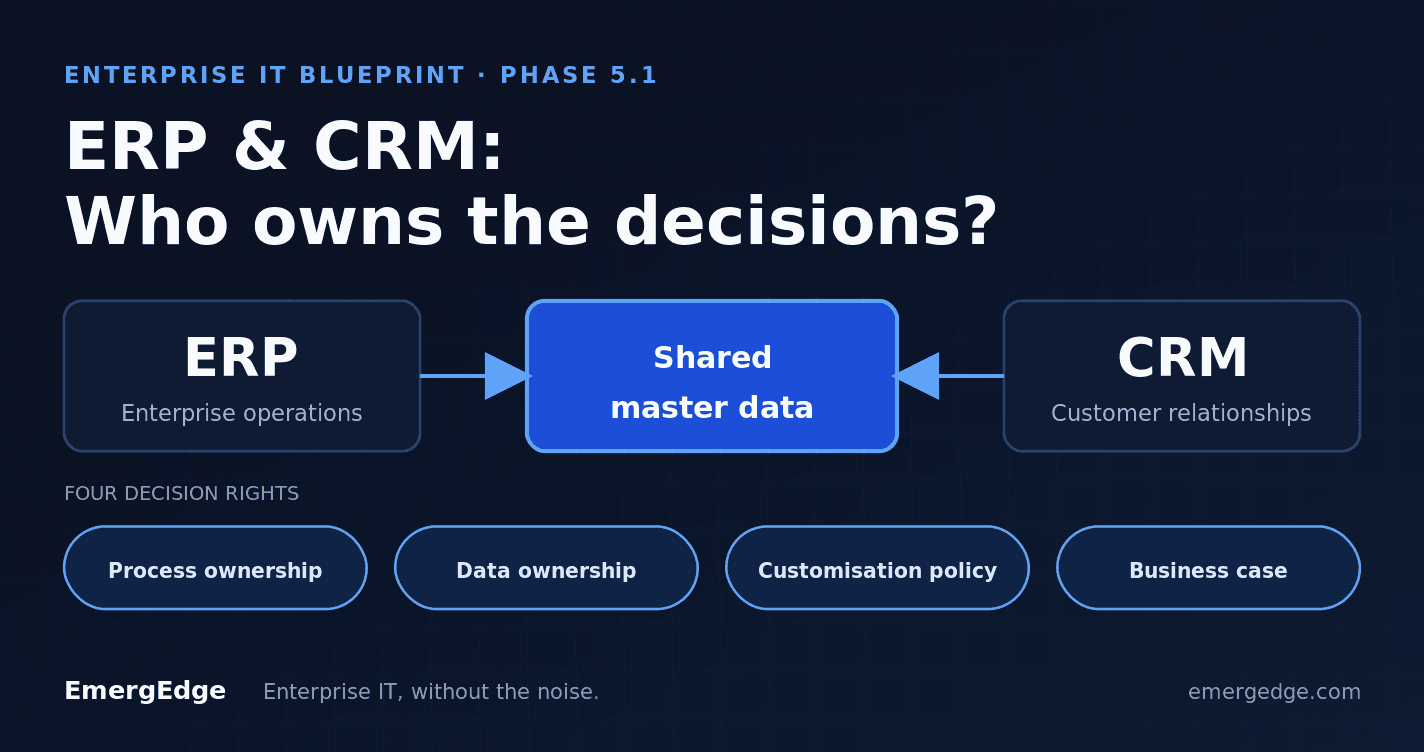
ERP and CRM are both called systems of record, but they record different things.
ERP holds the transactions that run the operation: finance, procurement, supply chain, manufacturing and HR. It is where a purchase order becomes a payment and a stock movement becomes an entry in the ledger. It is built for consistency and control, and it changes slowly on purpose.
CRM holds the relationship with the customer: who they are, what they have been offered, what they have bought and where the next opportunity sits. It is closer to the front line, it changes faster, and its quality depends on thousands of daily entries by people who have other priorities.
They are also tightly linked. A quote created in CRM becomes an order in ERP, then an invoice, then a payment, and the customer record has to mean the same thing at every step. Both programmes are technology projects with real architecture, integration and security demands, and none of that is optional. But their success depends heavily on decisions that are made, or avoided, before the first line of configuration.
Four Decision Rights Inside Every ERP and CRM Programme
1. Who owns the process? An end-to-end process such as order to cash crosses Sales, Finance, Logistics and Support. If every department owns its own step, nobody owns the whole. A named business process owner decides how the process should work and has the authority to say no to a change that helps one team and hurts another.
2. Who owns the data? A customer, a product and a supplier each need one agreed definition and one accountable owner. ERP tends to hold the contract and the invoice; CRM holds the relationship. If nobody decides which system is the authority for which attribute, both fill up with conflicting versions.
3. What is the customisation policy? Every customisation is a decision to carry extra cost through every future upgrade. Some are worth it, because they support a real competitive difference. Many are not. The policy should be set in advance: standard by default, and a customisation only when a business owner can justify it and fund it.
4. Who owns the business case? A programme sponsored by IT is a project. A programme sponsored by a business leader who has promised a result, and who will be asked about it a year later, is an investment. The sponsor's name should be written on the benefits.
One Customer, Three Records
Here is an illustrative composite, not a description of any one organisation.
A company has been selling to the same customer for years. In the CRM, the customer is an account with several contacts and a pipeline. In the ERP billing module, it is a bill-to entity with a credit limit. In the support tool, it is a company name typed in by whoever raised the ticket. The three records have different IDs and different spellings, and nobody agrees which one is correct.
Sales sees one revenue figure for the customer, Finance sees another, and Support cannot tell which contract applies. Each team fixes its own records in its own way. Reports disagree in every management meeting, so the company starts an integration project to reconcile them.
The project struggles. The integration is technically sound, but it cannot answer a question nobody has settled: what is a customer, and who decides? Is a subsidiary a separate customer or part of its parent? Which system wins when two records conflict? Without answers, every rule in the integration is an argument waiting to happen.
The missing decision was not technical. It was ownership. Someone with authority across Sales, Finance and Support had to define the customer, and name the owner who keeps that definition true. This is where CRM usually exposes a weakness the ERP programme was hiding. The ERP can enforce a rule, but a CRM only reflects what people choose to type, and they type what makes their own work easier unless the data has an owner.
Sourcing and Vendor Accountability
Platform decisions are also commercial decisions, and many of the weak points sit in the contract.
Know the licence and renewal terms. Subscription and licence models differ between vendors, and the cost of change is rarely visible at signing. Check renewal windows, price protection on renewals, and what happens to the price when your user count or modules grow.
Plan the exit before you enter. Ask how you would get your data out, in what format, at what cost and in what timeframe. If the answer is unclear at signing, it will be worse in year five.
Decide who answers when things go wrong. A programme usually involves a vendor and a systems integrator. When delivery slips, each can point to the other. The contract and the governance structure should say who is accountable for what, before the first problem.
Ask for evidence. Gartner's 2026 advice to finance leaders evaluating cloud ERP applications is to insist on transparent pricing and referenceable customer adoption, and to invest in data governance. That advice was written for AI-enabled finance applications, but the instinct applies more widely: reference customers of similar size and complexity tell you more than a demonstration.
Contract management has a quieter benefit. An organisation that knows its renewal dates, scope and service levels, and checks them, is negotiating from a position of knowledge instead of urgency.
Six Questions Before You Select, Upgrade or Renew
- Who is the named business owner of the end-to-end process this platform supports?
- Who owns each core data set, such as customer, product and supplier, and which system is the authority for each?
- What is our customisation policy, and who approves an exception?
- Which measurable business outcomes will this deliver, and who is accountable for them after go-live?
- What do the contract and the support timeline say about cost, renewal, exit and accountability between vendor and integrator?
- How and when will we verify, after go-live, that the expected value arrived?
If you cannot answer the first four, the platform choice is not your biggest risk yet.
What This Means for IT Leaders
ERP and CRM are among the largest and most visible investments an enterprise makes, and they are among the hardest to change once they are in place. The technology matters, and so do architecture, integration and security. But the decisions that shape the result are about ownership: of the process, the data, the customisation rules and the outcome.
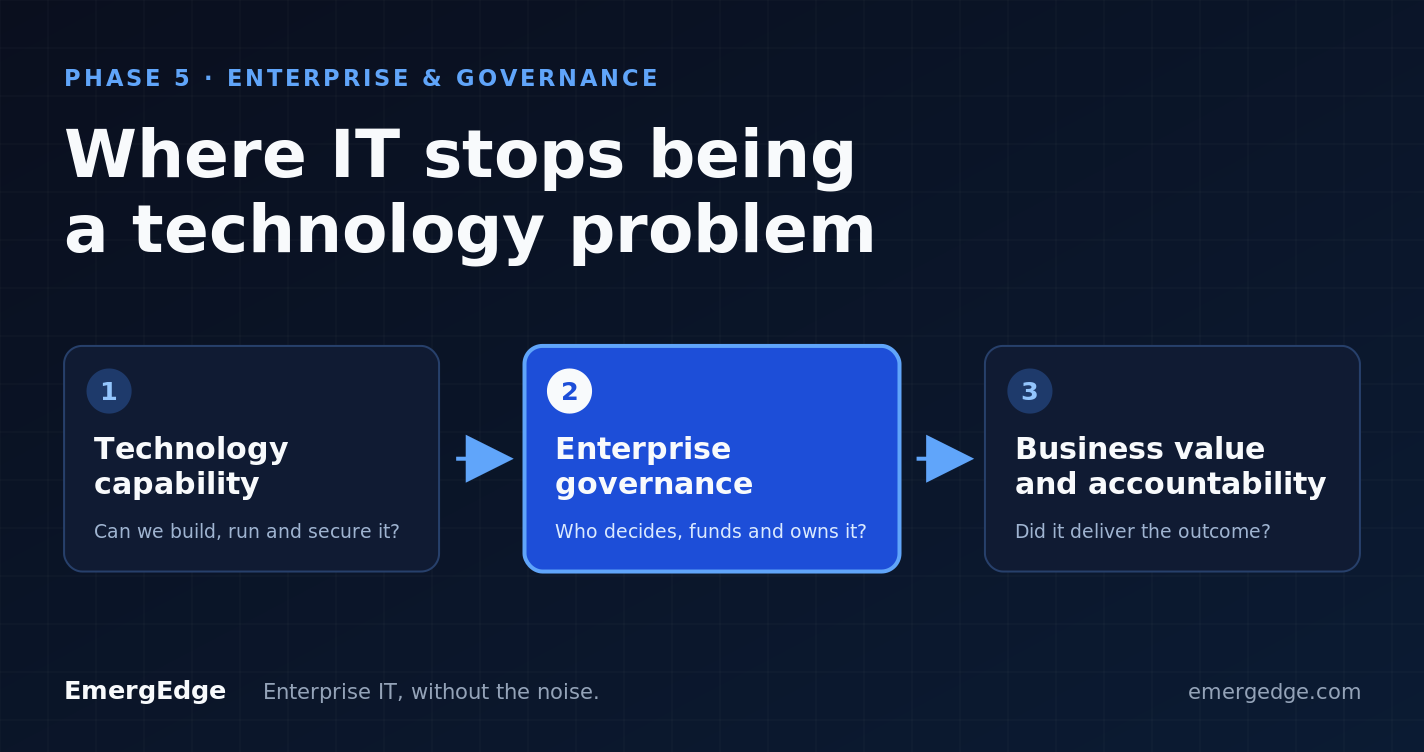
That is why Phase 5 treats them as governance topics. In 5.2, we look at the frameworks and architecture that help organisations make those decisions consistently, and at what COBIT, ITIL and the ISO standards each do, and where they differ.
Sources: SAP, "Innovation Commitment for SAP S/4HANA until 2040" (maintenance strategy for SAP Business Suite 7), SAP News, "Planning Beyond 2030", October 2026, Gartner, "Gartner Predicts Embedded AI in Cloud ERP Applications will Drive a 30% Faster Financial Close by 2028," February 24, 2026.