In almost every IT leadership conversation about project delivery, someone uses PMP and PMO interchangeably. Sometimes it is a junior team member who is still learning the landscape. Occasionally it is a CIO who has been in the role for years and never had anyone clearly explain the difference.
The confusion is understandable. Both acronyms contain "PM." Both relate to project management. Both matter significantly to how IT organisations deliver. But they are fundamentally different things — one is a professional credential held by an individual, the other is an organisational function — and conflating them leads to hiring the wrong people, building the wrong structures, and setting the wrong expectations.
What Is the PMP?
The PMP — Project Management Professional — is a certification awarded by the Project Management Institute to individuals who demonstrate a defined level of project management knowledge and experience.
To earn the PMP, a candidate must have a minimum number of hours leading projects — 4,500 hours with a four-year degree or 7,500 hours without — and pass a rigorous examination that covers project planning, execution, monitoring, change management, and stakeholder communication across predictive, agile, and hybrid delivery approaches.
The PMP credential signals that the individual holding it has a structured understanding of project management methodology, has demonstrated real-world experience managing projects, and has committed to ongoing professional development through continuing education requirements to maintain the certification.
What the PMP does not guarantee is that the holder is a great project manager in practice. Like any professional credential, it is a baseline indicator of knowledge and experience, not a predictor of performance. A PMP who has managed projects in a context very different from yours will bring knowledge but will need time to translate it. A highly effective project manager without a PMP may outperform a certified holder in the right environment.
The PMP is best understood as a quality signal — a useful filter in hiring and procurement — not as a sufficient condition for project management success.
What Is the PMO?
The PMO — Project Management Office — is an organisational function, not a person and not a credential. It is a team, a department, or a set of capabilities within an organisation that is responsible for defining, maintaining, and ensuring adherence to project management standards, processes, and governance across the portfolio of projects.
The PMO exists to bring consistency, visibility, and governance to an organisation's project delivery. Without a PMO, project management practices tend to vary widely across teams and project managers — each using their own templates, reporting formats, risk frameworks, and escalation processes. The result is a portfolio that is difficult to manage, hard to report on, and prone to surprises.
The scope and authority of a PMO varies significantly depending on the organisation's size, maturity, and delivery model.
Supportive PMOs provide tools, templates, training, and guidance but leave execution authority with project teams. They add value without creating overhead.
Controlling PMOs establish mandatory standards and require project managers to use defined processes, tools, and reporting formats. They create consistency at the cost of some flexibility.
Directive PMOs take direct ownership of projects, assigning and managing project managers centrally. They maximise consistency and control but require significant investment and can create distance between delivery teams and business stakeholders.
Most enterprise IT organisations operate somewhere between the supportive and controlling models, calibrating the level of oversight to the complexity and risk profile of their project portfolio.
The Practical Difference in Daily Operation
To make the distinction concrete, consider what each looks like in practice.
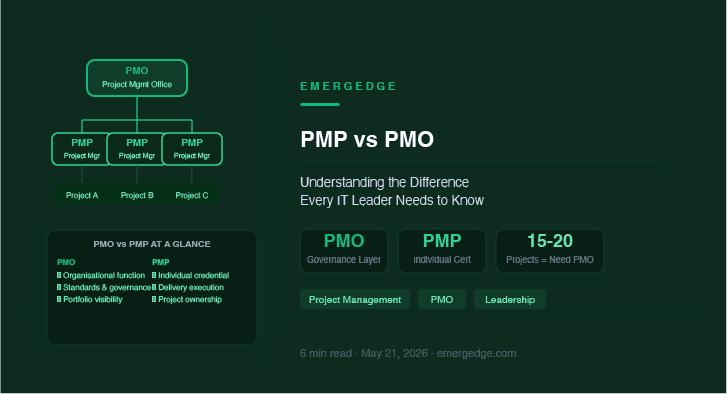
A PMP in your organisation is a project manager — an individual contributor or team lead — who plans and executes specific projects. They create project plans, manage schedules and budgets, identify and mitigate risks, communicate with stakeholders, and drive delivery. They are accountable for the outcome of their specific projects.
The PMO in your organisation is the governance layer above individual projects. It maintains the project methodology, provides the reporting framework, monitors the health of the overall portfolio, escalates issues that cross project boundaries, allocates resources across competing projects, and provides the executive leadership with a coherent view of everything in flight.
A PMP works within the PMO's framework. The PMO creates the framework that PMPs and all project managers work within.
Why Organisations Get This Wrong
The most common mistake is treating the PMO as a team of senior project managers whose primary job is to run the biggest projects. This misses the point entirely. When the PMO is focused on project execution rather than governance, two things happen simultaneously: the biggest projects get reasonable oversight, and the portfolio as a whole loses the consistency and visibility it needs.
The second common mistake is building a PMO without sufficient authority. A PMO that publishes templates and guidance but cannot enforce compliance becomes a bureaucratic overhead that adds cost without adding governance value. PMO authority must be commensurate with PMO responsibility.
The third mistake is staffing the PMO entirely with people who have never delivered projects. PMO leaders who have not personally managed complex projects under pressure lack the credibility to set standards that project managers will respect and follow.
How to Structure the Relationship
The most effective IT organisations structure the PMO and their project management professionals with clear accountability at each level.
The PMO owns methodology, standards, portfolio visibility, resource governance, and executive reporting. It is led by a Head of PMO or Portfolio Director who reports to the CIO or equivalent.
Individual project managers — PMP-certified or otherwise — own delivery of specific projects within the PMO's framework. Senior project managers may own programmes comprising multiple related projects.
The PMO provides support and governance to project managers. Project managers provide execution and portfolio data to the PMO. The relationship is symbiotic, not hierarchical in the management sense.
When to Invest in Each
For early-stage or smaller IT organisations, the priority is typically hiring strong project managers — PMP-certified where possible — before investing in a formal PMO function. A small team with consistent methodology and good communication can deliver well without a formal governance layer.
As the organisation scales — typically beyond 15 to 20 concurrent projects or 50 to 100 IT staff — the absence of a PMO starts to create real pain. Portfolio visibility deteriorates. Resource conflicts multiply. Escalations land on the CIO's desk because there is no governance layer to manage them. At this point, investing in PMO capability is not overhead — it is essential infrastructure for delivery at scale.
Conclusion
The PMP is a credential that signals an individual's knowledge and experience in project management. The PMO is an organisational function that creates the governance framework within which projects are planned, executed, and monitored.
Both matter. Neither replaces the other. And the IT organisations that confuse them — either by treating PMPs as a substitute for PMO governance or by treating the PMO as a vehicle for managing big projects rather than governing a portfolio — consistently underdeliver relative to their potential.
Clarity on this distinction is not just semantic. It shapes how you hire, how you structure, and how you govern. Getting it right is one of the simpler things an IT leader can do to improve delivery outcomes across the board.