For decades, project management has been built on a foundation of human judgement. A skilled project manager reads the room, senses when a deadline is slipping before the Gantt chart shows it, and knows which stakeholder needs a phone call instead of an email.
That foundation is not going away. But everything built on top of it is changing.
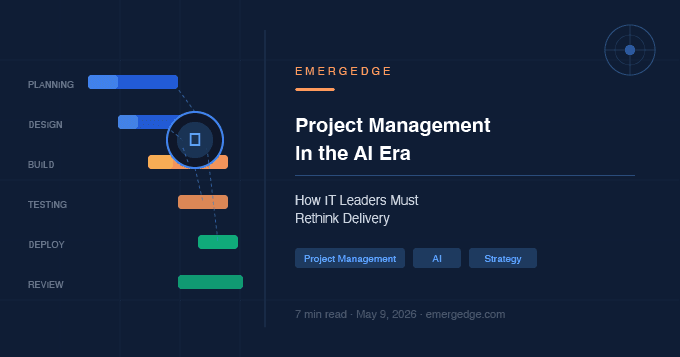
AI is entering the project management lifecycle at every stage — from planning to risk assessment to resource allocation to retrospectives. The project managers and IT leaders who understand where AI genuinely helps, where it introduces new risks, and what it cannot replace will be the ones delivering successfully in the next five years.
The Old Model Is Cracking
Traditional project management frameworks — PRINCE2, PMI, even Agile at scale — were designed for human teams operating at human speed. Status updates happen weekly. Risk registers get reviewed monthly. Resource conflicts surface when someone misses a milestone.
AI-driven projects break these assumptions in two ways.
First, AI components in a project behave differently from software components. A traditional software module either works or it doesn't. An AI model performs probabilistically — it might work 94% of the time in testing and 78% in production, with failures that are hard to predict and harder to explain. Standard quality gates are not designed for this.
Second, AI is compressing delivery timelines in ways that make traditional governance feel slow. When a developer can generate a working prototype in hours instead of weeks, the old rhythm of sprint planning, backlog grooming, and two-week cycles starts to feel like it's adding friction rather than reducing it.
Where AI Is Actually Helping Project Managers Right Now
The most immediate value is in the areas project managers have always found most painful: documentation, reporting, and pattern recognition across large datasets.
Automated status reporting is the obvious win. AI tools can now pull data from Jira, Azure DevOps, or ServiceNow and generate executive-ready status reports in seconds. Project managers who used to spend Friday afternoons writing updates are using that time for actual problem-solving.
Risk identification from historical data is more interesting. AI models trained on past project data can flag early warning signs — budget variance patterns, team velocity drops, stakeholder engagement signals — that human project managers might miss until it's too late. Several enterprise PMO tools are already embedding this capability.
Meeting intelligence is becoming standard. AI transcription and summarisation tools don't just record what was said — they identify decisions made, actions assigned, and blockers raised, and feed them directly into project tracking systems. The manual overhead of meeting notes is effectively gone.
Resource optimisation is where enterprise-grade AI project tools are creating the most measurable ROI. Matching skill sets to tasks, identifying underutilisation, and flagging burnout risk before it hits delivery — these are problems that have always existed and that AI handles significantly better than spreadsheets.
The New Risks Nobody Is Talking About
Every efficiency gain comes with a corresponding risk. For AI in project management, there are three that deserve serious attention.
Over-reliance on AI confidence scores. AI risk tools don't say "this project will fail." They say "this project has a 73% probability of missing its deadline." Project managers who treat these scores as facts rather than inputs are making the same mistake as traders who trusted credit ratings in 2008.
Accountability gaps in AI-assisted decisions. When a project manager uses an AI recommendation to reassign resources and the project misses a critical milestone, who is accountable? The project manager. Always. But the paper trail gets murky when the decision was "suggested by the tool." Project governance frameworks need to be updated to reflect this.
Speed without clarity. AI can accelerate delivery — but accelerating in the wrong direction faster is not progress. The fundamental discipline of defining clear requirements, measurable success criteria, and stakeholder alignment before building anything has not been automated. When AI tools make it easier to start building, the temptation to skip discovery and definition grows.
What Project Managers Need to Do Differently
The project managers who will thrive in the AI era are not the ones who know the most AI tools. They are the ones who have developed three new disciplines.
AI literacy as a project skill. Understanding how AI components work well enough to ask the right questions about reliability, bias, and failure modes. Not at a data science level — but enough to challenge vendor claims and set realistic expectations with stakeholders.
Outcome-based planning over activity-based planning. When AI can generate code, documentation, and test cases faster than any human, measuring delivery by tasks completed becomes meaningless. The shift is to measuring value delivered — does the output solve the problem it was designed to solve?
Human-centred change management. AI projects almost always involve changes to how people work. The technical delivery is often the easy part. The change management — helping people understand what AI will do, what it won't do, and why their role is changing — is where most AI projects struggle. This is irreducibly human work.
The Framework Nobody Has Agreed On Yet
The honest truth is that the project management profession has not yet reached consensus on how to manage AI-enabled projects. PMI, Agile Alliance, and major consulting firms are all developing frameworks, but none has become the standard.
This creates an opportunity for IT leaders who are willing to develop their own approach based on what actually works in their organisation rather than waiting for an industry framework to arrive.
The organisations building this capability now — developing their own AI project playbooks, training their project managers in AI fundamentals, and building governance structures that account for AI-specific risks — will have a significant advantage over those waiting for the profession to catch up.
Conclusion
AI is not making project management obsolete. It is making it more demanding.
The project manager of 2026 needs everything the project manager of 2016 needed — communication skills, stakeholder management, risk awareness, delivery discipline — and they need to add AI literacy, outcome-based thinking, and a deeper understanding of how to govern probabilistic systems.
The tools are getting smarter. The job is getting harder. The leaders who lean into that complexity rather than hoping it resolves itself will define what great project delivery looks like in the AI era.