There is a pattern that repeats in enterprise data initiatives with remarkable consistency. An organisation invests in a business intelligence platform. The dashboards go live. Executives begin using the reports. Within weeks, someone notices that the revenue figure in the sales dashboard does not match the revenue figure in the finance system. An investigation reveals that the two systems use different definitions of revenue — one includes returns, one does not. The data team spends three months resolving the discrepancy. By the time they finish, confidence in the analytics platform has been damaged in ways that take years to repair.
This is not a technology problem. It is a governance problem.
The absence of a shared definition of "revenue" — agreed, documented, and enforced — is a data governance failure. The existence of two authoritative sources for the same data element is a master data management failure. And these failures are not edge cases. In most enterprises that have grown through acquisition, organic expansion, or the accumulation of SaaS applications over a decade, they are the norm.
Data governance and master data management are the disciplines that prevent this pattern — and increasingly, they are the disciplines that determine whether an organisation's AI and analytics investments deliver their potential value or simply surface the chaos that exists in the underlying data.
What Data Governance Actually Is
Data governance is the framework of policies, processes, roles, and standards that ensure data is managed as a strategic asset throughout its lifecycle. It answers the questions that organisations without governance cannot answer: Who owns this data? What does it mean? How was it created? Who can access it? How accurate is it? How long should we keep it?
Governance does not manage data directly — that is the role of the systems and platforms. Governance defines and enforces the rules by which data is managed. The distinction matters because it clarifies that governance is fundamentally an organisational and process challenge, not a technology challenge. Technology enables governance — data catalogs, quality platforms, and lineage tools make governance operational at scale — but no tool substitutes for the human decisions about ownership, definition, and accountability that governance requires.
The Three Pillars of Effective Data Governance
Data ownership and stewardship. Every data domain — customer, product, financial, operational — needs a named business owner who is accountable for its quality, definition, and appropriate use. Data stewards, typically domain experts within business functions, operationalise those accountabilities day to day. Without defined ownership, governance conversations collapse into debate about who is responsible. With it, they become productive conversations about how to improve.
Data quality management. Quality has multiple dimensions: accuracy (does the data reflect reality?), completeness (are all required fields populated?), consistency (does the same data mean the same thing across systems?), timeliness (is the data current enough to be useful?), and uniqueness (are there duplicate records?). Each dimension requires different monitoring and remediation approaches. Data quality management is the discipline of defining quality standards, measuring performance against them, identifying root causes of quality failures, and driving systematic improvement.
Data definitions and standards. A data dictionary or business glossary — a managed catalogue of agreed definitions for every significant data element — is the foundation of consistent analytics. When the finance team and the sales team disagree about the revenue figure, the resolution is not technical. It is definitional: agreeing what revenue means, documenting it, and ensuring every system that produces or consumes that data element uses the agreed definition.
Master Data Management
Master data management (MDM) addresses a specific and critical data governance problem: the existence of multiple versions of the same real-world entity across different systems. A customer who exists in the CRM, the billing system, the support platform, and the e-commerce platform as four slightly different records creates analytical, operational, and regulatory problems that ripple across the entire organisation.
MDM establishes a single, trusted, authoritative record for each entity — the "golden record" — and ensures that all systems that reference that entity use the same consistent version.
The Four MDM Architectural Patterns
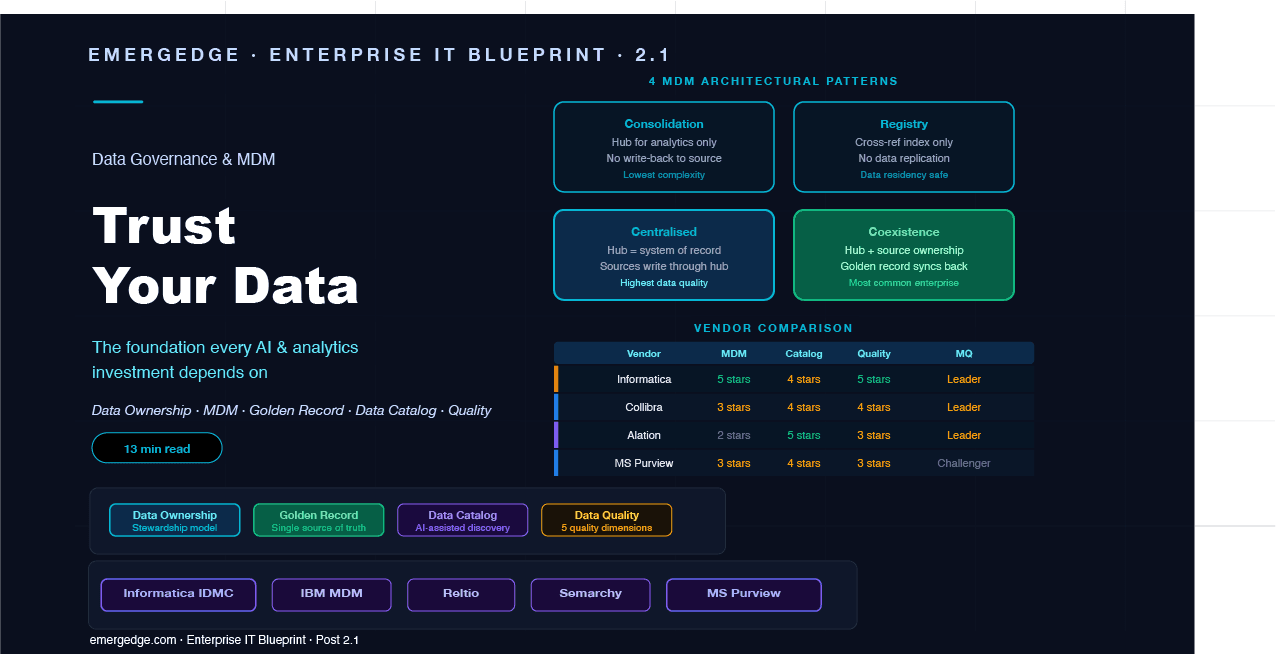
Consolidation style. Data from source systems is consolidated into a central MDM hub for analytical purposes. The hub provides a clean, reconciled view of master data but does not write back to source systems. Lowest implementation complexity. Best for analytics use cases where operational systems continue to operate independently.
Registry style. The MDM hub maintains a cross-reference index that maps records across source systems without replicating the data. Each system retains ownership of its own records; the registry provides the linkage. Very low data duplication. Best for organisations with strong source system governance and complex data residency requirements.
Centralised style. The MDM hub becomes the system of record for master data — source systems create and update records through the hub, which distributes the authoritative version. Highest data quality. Most significant implementation complexity and organisational change requirement.
Coexistence style. A hybrid combining centralised and consolidation: source systems retain operational ownership but a central hub maintains the authoritative golden record and synchronises back to sources. The most common enterprise pattern for organisations with many existing source systems.
The Six Master Data Domains
The most commonly managed master data domains in enterprise organisations are Customer (or Party), Product, Location (or Site), Asset, Employee, and Financial (Chart of Accounts). The priority for MDM investment is almost always Customer master data — the downstream impacts of inconsistent customer records on marketing, sales, service, and regulatory compliance are the most immediately visible and most expensive.
The Data Catalog
A data catalog is the operational technology for data governance — the searchable inventory of all data assets in the enterprise, enriched with business context, technical metadata, quality scores, lineage information, and usage statistics.
The value proposition of a data catalog operates at two levels. For data consumers — analysts, data scientists, business users — it answers the question "what data exists and where can I find it?" For data governance professionals, it provides the foundation for managing data quality, tracking lineage from source to report, and demonstrating regulatory compliance.
Modern data catalogs — Collibra, Alation, Informatica Axon, Microsoft Purview — are AI-assisted. They automatically discover data assets across the organisation, suggest classifications, infer lineage, and recommend quality improvements. The manual effort required to build and maintain a catalog has reduced dramatically, removing one of the primary objections to governance investment.
The Gartner Magic Quadrant Landscape
Gartner evaluates the data governance and MDM market across several quadrants. The primary relevant quadrants are the Magic Quadrant for Augmented Data Quality Solutions and the Magic Quadrant for Master Data Management Solutions.
In the MDM space, consistent Leaders include Informatica, Reltio, and Stibo Systems. Informatica leads on breadth and enterprise integration depth; Reltio has built a cloud-native MDM platform with strong AI-assisted matching; Stibo Systems is strongest in product MDM for retail and manufacturing environments.
For data quality and governance platforms, Informatica, Collibra, and Alation are consistent Leaders, with Microsoft Purview rapidly gaining relevance for Microsoft-centric organisations through its native integration with the Azure data platform.
Vendor Comparison
| Dimension | Informatica | Collibra | Alation | Microsoft Purview | Reltio |
|---|---|---|---|---|---|
| Primary strength | MDM + Data Quality | Data Governance | Data Catalog | Azure-native | Cloud MDM |
| MDM capability | ★★★★★ | ★★★☆☆ | ★★☆☆☆ | ★★★☆☆ | ★★★★★ |
| Data catalog | ★★★★☆ | ★★★★☆ | ★★★★★ | ★★★★☆ | ★★★☆☆ |
| Data quality | ★★★★★ | ★★★★☆ | ★★★☆☆ | ★★★☆☆ | ★★★★☆ |
| AI-assisted | ★★★★☆ | ★★★★☆ | ★★★★★ | ★★★★☆ | ★★★★☆ |
| Microsoft integration | ★★★★☆ | ★★★★☆ | ★★★☆☆ | ★★★★★ | ★★★☆☆ |
| Enterprise scale | ★★★★★ | ★★★★★ | ★★★★☆ | ★★★★☆ | ★★★★☆ |
| Best for | Complex MDM + quality | Governance programs | Data discovery | Azure shops | Customer/party MDM |
What to Do Next
Three questions that determine data governance priority:
1. Can your organisation produce a single, agreed revenue figure that every function accepts as authoritative? If the answer is no — or "it depends on which system you use" — you have a master data management problem at the most basic level.
2. Do your data scientists and analysts spend more than 30% of their time finding and cleaning data rather than analysing it? This is the most reliable indicator of data governance maturity. In organisations with mature governance, this ratio inverts — analysts spend the majority of their time on analysis.
3. Could you demonstrate to a regulator today exactly where every piece of personally identifiable customer data is stored, how it was collected, and who has accessed it? If the answer is uncertain, regulatory exposure is real and growing.
The next post in this category covers Business Intelligence & Analytics — the layer where governed, trusted data becomes business decisions.