For thirty years, enterprise datacenters were cooled the same way. Cold air was pushed up through perforated floor tiles, drawn through equipment front-to-back, exhausted as hot air into a contained hot aisle, and returned to computer room air conditioning units for recooling. The system worked. It was understood. The entire supply chain — racks, cabinets, floor tiles, CRAC units, precision air handlers — was optimised for it.
That era is ending.
Not gradually. Not incrementally. The shift from traditional air cooling to liquid cooling is one of the fastest infrastructure transitions the datacenter industry has ever experienced, driven by a single forcing function that air cooling simply cannot answer: the thermal output of AI accelerators.
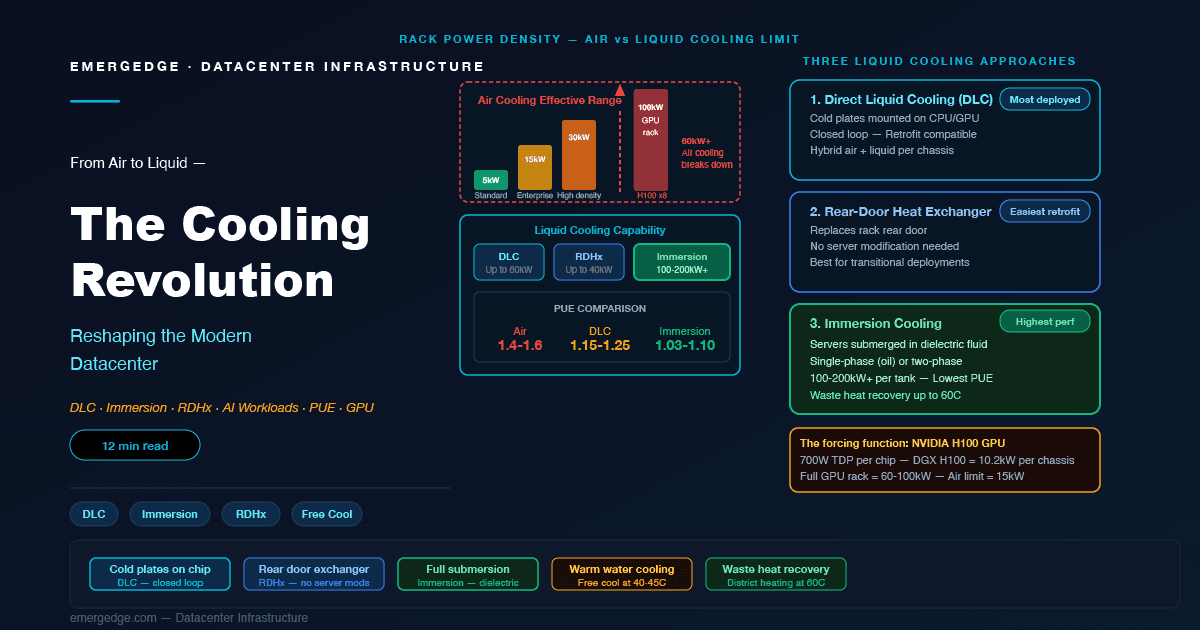
An NVIDIA H100 GPU — the current enterprise standard for large language model training and inference — has a thermal design power (TDP) of 700 watts. A DGX H100 system containing eight H100 GPUs produces 10.2 kilowatts of heat from a single 10U chassis. A fully populated rack of GPU servers can easily reach 60–100 kW of heat output. Traditional air cooling is designed for racks of 5–15 kW. At 100 kW per rack, the physics of air cooling break down — not as an engineering preference but as a thermodynamic reality.
This is why the industry is moving, and moving fast.
Why Air Cooling Is Reaching Its Limits
Traditional air cooling relies on moving large volumes of air across heat-generating components. Air has a low thermal capacity — it can only carry a limited amount of heat per unit volume before it becomes too hot to effectively cool the components it is flowing over.
The constraint is expressed in the relationship between rack power density, airflow volume, and supply air temperature. At 15 kW per rack — the design point for most enterprise datacenters built before 2020 — a well-designed air cooling system with hot-aisle containment and precision air handlers can maintain component temperatures within safe operating ranges. At 30 kW, it requires significant infrastructure investment and careful airflow management. At 60 kW and above, the volumes of air required to maintain adequate cooling become physically impractical — the air velocities required would be damaging to equipment, and the energy consumed by fans and CRAC units would approach or exceed the IT load itself.
The PUE (Power Usage Effectiveness) implication is significant. In a dense AI workload environment, air cooling can consume 30–40% of total facility power just for cooling. Liquid cooling systems, by contrast, can reduce cooling overhead to 5–10% of total facility power, driving PUE improvements from typical air-cooled values of 1.4–1.6 down to 1.1–1.2.
For large-scale AI deployments, the energy cost difference is not marginal. It is transformative.
The Three Liquid Cooling Approaches
Liquid cooling is not a single technology. It is a spectrum of approaches, each with different performance characteristics, implementation complexity, and compatibility with existing infrastructure.
Direct Liquid Cooling (DLC) — Cold Plates
Direct liquid cooling brings liquid cooling directly to the chip — a cold plate (a metal block with internal channels for liquid flow) is mounted directly on the processor or GPU package, replacing the traditional air-cooled heat sink. Coolant flows through the cold plate, absorbing heat from the chip junction, and is carried away to a facility cooling circuit.
DLC is the most widely deployed form of liquid cooling in enterprise datacenters today. It is compatible with standard rack form factors and can be retrofitted to existing rack infrastructure. The cooling liquid — typically water or a water-glycol mixture — operates in a closed loop, eliminating concerns about liquid in contact with electronics. Most DLC implementations operate in a hybrid configuration: liquid cooling handles the highest-power components (CPUs and GPUs), while residual heat from other components (memory, storage, networking) is managed by supplemental air cooling within the same chassis.
Major server OEMs — Dell, HPE, Lenovo, Supermicro — now offer DLC-ready server platforms for GPU-intensive workloads. NVIDIA's DGX H100 NVL system is factory-configured for DLC. The technology is mature, the supply chain is developing rapidly, and adoption is accelerating.
Best for: High-performance computing, AI training clusters, environments where retrofitting existing data hall infrastructure is necessary or preferred.
Rear-Door Heat Exchangers (RDHx)
A rear-door heat exchanger replaces the standard perforated rear door of a server rack with a door containing a liquid-cooled heat exchanger. Hot exhaust air from the servers passes through the heat exchanger before entering the hot aisle, transferring heat to the cooling liquid. The air leaving the rack rear door is cooled — sometimes to below room temperature — eliminating the heat load from the hot aisle entirely.
RDHx is attractive because it requires minimal changes to the servers themselves and is relatively straightforward to retrofit in existing facilities. The limitation is thermal capacity — RDHx can effectively handle rack densities up to approximately 30–40 kW, beyond which the airflow volumes required within the rack outpace what a rear-door heat exchanger can effectively manage.
Best for: Transitional deployments, moderate-density environments, facilities where server modification is not feasible.
Immersion Cooling — Single-Phase and Two-Phase
Immersion cooling submerges servers directly in a dielectric fluid — a liquid that does not conduct electricity. The servers operate normally while fully submerged; the dielectric fluid absorbs heat from all components simultaneously and is either circulated through an external heat exchanger (single-phase) or evaporates and recondenses in a closed loop (two-phase).
Single-phase immersion cooling uses dielectric oils or engineered fluids (3M Novec, Engineered Fluids, Submer). Servers are submerged in tanks of fluid, fans are removed from the servers, and the fluid is pumped through an external coolant-to-water heat exchanger. Effective rack densities of 100–200 kW per tank are achievable.
Two-phase immersion cooling uses a low-boiling-point fluid that vaporises when in contact with hot components, carries heat away as vapour, and condenses on a cooled coil mounted above the fluid level. The condensed liquid falls back into the tank. Two-phase systems achieve excellent thermal performance but require more careful management of fluid integrity and are more sensitive to maintenance procedures.
The primary challenge of immersion cooling is operational: the familiar processes for server deployment, maintenance, cable management, and troubleshooting change significantly. Server warranty implications vary by OEM. The supply chain for immersion-ready server configurations is developing but not yet as mature as DLC.
Best for: Ultra-high density AI training facilities, new construction where operational procedures can be designed around immersion from the outset, organisations willing to invest in operational transformation for maximum thermal and energy efficiency.
The Facility Infrastructure Implications
The shift to liquid cooling is not only a server-level change — it requires rethinking facility infrastructure at multiple levels.
Chilled water and cooling water circuits become first-class infrastructure rather than peripheral support systems. In a liquid-cooled facility, the piping, manifolds, leak detection systems, and fluid management infrastructure are as critical to uptime as the power distribution system.
Water quality and treatment becomes an operational discipline. Scaling, corrosion, and biological growth in cooling water circuits are real reliability risks that air-cooled facilities do not face. Conductivity monitoring, biocide treatment, and filtration are ongoing operational requirements.
Leak detection is non-negotiable. Even in closed-loop DLC systems using deionised water, a leak in a liquid distribution unit or server cold plate can cause rapid equipment damage. Leak detection cables, drip trays, and automatic shutoff valves are standard requirements for liquid-cooled facilities.
Warm water cooling is an important enabler. Unlike traditional air cooling, which requires chilled water at 7–12°C, many liquid cooling systems can operate effectively with warm water at 40–45°C. This enables free cooling — using ambient air or evaporative cooling to produce the required water temperature without mechanical refrigeration — significantly extending the hours per year that cooling energy consumption approaches zero.
Waste heat recovery becomes viable at scale. DLC and immersion cooling return liquid at 40–60°C — temperatures high enough to be useful for space heating, domestic hot water, or low-grade industrial processes. Several European hyperscale facilities have implemented district heating integration that recovers datacenter waste heat for residential and commercial use, contributing to sustainability targets and creating a revenue offset against cooling energy costs.
The Market Landscape
The liquid cooling market has attracted significant investment and activity from established cooling vendors and new entrants.
Vertiv, Schneider Electric, and Emerson — the established leaders in datacenter cooling infrastructure — have all developed liquid cooling product lines alongside their traditional air cooling portfolios. These vendors offer the advantage of integrated facility solutions and established relationships with datacenter operators.
Submer, Asperitas, and Liquidstack are specialist immersion cooling vendors who have built from the ground up for liquid environments. They tend to offer more mature immersion-specific designs and operational expertise.
On the server side, all major OEMs now offer liquid-cooling-ready platforms. NVIDIA has made DLC compatibility a standard feature of its latest generation AI platforms. Intel and AMD have published reference thermal specifications for liquid-cooled deployments of their latest AI accelerator products.
What IT and Facility Leaders Should Do Now
The decision is not whether to adopt liquid cooling. For organisations planning significant AI infrastructure deployment in the next three to five years, the thermal output of GPU-class workloads makes the decision for you. The decision is which approach, in which sequence, and how to manage the transition.
For existing facilities: Assess current power density distribution. Most enterprise datacenters have pockets of high-density AI workloads alongside standard server infrastructure. DLC or RDHx for the high-density zones — while maintaining air cooling for standard workloads — is the pragmatic transition path.
For new construction: Design for liquid cooling from the outset. The incremental cost of incorporating liquid cooling infrastructure into a new design is a fraction of the retrofit cost. Chilled water circuits routed to the row level, supplemental liquid distribution unit (LDU) infrastructure, and hot aisle structures designed for hybrid air/liquid operation provide the flexibility to serve both current and future workload densities.
For facility managers: Engage with cooling vendors and OEMs now. The supply chain for liquid cooling infrastructure — especially immersion-cooling-ready tanks and DLC-compatible server configurations — has lead times that are incompatible with last-minute procurement decisions.
For sustainability officers: The energy efficiency case for liquid cooling is compelling and quantifiable. The reduction in cooling PUE overhead, combined with waste heat recovery opportunities, creates a business case that extends well beyond the IT infrastructure budget.
The Bottom Line
The shift from air to liquid cooling is not a trend. It is a structural change in datacenter infrastructure driven by the thermal physics of the workloads that enterprises increasingly depend on. The organisations that understand this transition early — and plan their facility investments accordingly — will build AI-capable infrastructure at significantly lower cost and energy intensity than those who retrofit under pressure.
The question is no longer whether your next significant infrastructure investment should include liquid cooling. It is which form of liquid cooling, deployed in which sequence, with what facility infrastructure foundation.
The air-cooled datacenter is not going away tomorrow. But the era in which it was the only answer for enterprise IT infrastructure is already over.