Every IT leader faces this decision more often than they would like. A new capability is needed, a team is stretched, or a project requires skills that don't exist in-house. The question is always the same: do we hire, or do we outsource?
The answer most organisations arrive at is driven by instinct, internal politics, or whichever option the most senior person in the room prefers. Very few IT leaders approach this decision with the financial rigour and operational clarity it deserves.
That is a costly mistake. Made consistently across a large IT organisation, it is an extremely costly one.
Why the Question Is Harder Than It Looks
On the surface, the comparison seems straightforward. Hiring gives you permanent capacity and institutional knowledge. Outsourcing gives you flexibility and access to specialised skills. Pick based on your situation.
The problem is that most organisations are not comparing equivalent things. When they calculate the cost of hiring, they think about salary. When they calculate the cost of outsourcing, they think about the vendor invoice. Neither figure is complete.
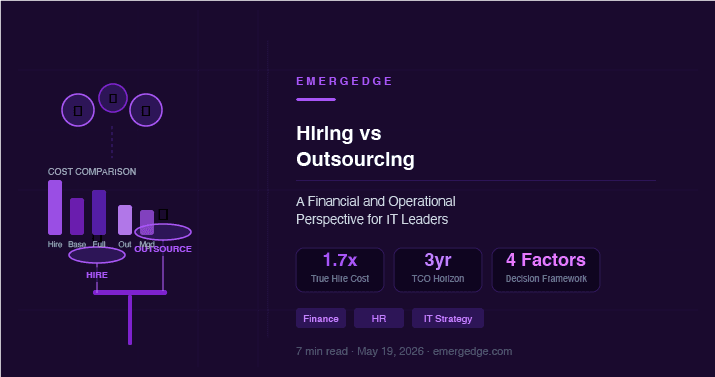
The fully loaded cost of a permanent hire includes salary, employer contributions, benefits, office space, equipment, onboarding time, management overhead, training, and the cost of eventual offboarding. In most markets, the fully loaded cost of an employee is 1.3 to 1.7 times their base salary. This is before accounting for the months it takes a new hire to reach full productivity.
The fully loaded cost of outsourcing includes the vendor rate, the internal management overhead of the relationship, the transition cost if the vendor changes, the risk premium for dependency on an external party, and the knowledge that leaves when the engagement ends.
Neither side of the ledger is as clean as it first appears.
The Financial Framework
A rigorous comparison starts with total cost of ownership over a meaningful time horizon — typically three years, which is long enough to see the real economics on both sides.
Break-even analysis is the most useful tool. At what utilisation level and over what time period does hiring become cheaper than outsourcing? The break-even point depends on the fully loaded cost of the hire, the vendor rate, the ramp-up time to productivity, and the expected duration of the demand.
For a permanent demand pattern — a capability the organisation will need continuously for the foreseeable future — the economics of hiring improve significantly. For episodic or peak demand, outsourcing economics are usually superior regardless of headline rates.
Hidden cost identification is the second discipline. The most commonly missed costs on the hiring side are productivity loss during the recruitment period, the management burden on existing team members covering the gap, and the risk cost of a bad hire. A failed hire at senior level can cost two to three times annual salary when you account for recruitment fees, lost productivity, and the cost of the replacement process.
The most commonly missed costs on the outsourcing side are the internal effort required to manage the relationship, the rework that occurs when handoffs are unclear, the knowledge gap that accumulates when external parties hold critical institutional knowledge, and the price escalation risk over multi-year engagements.
Risk-adjusted comparison is the third layer. Hiring carries concentration risk — if a key permanent employee leaves at a critical moment, the impact can be severe. Outsourcing carries dependency risk — if the vendor relationship deteriorates or the vendor exits the market, the transition cost can be significant. The risk-adjusted cost comparison should reflect the probability and impact of these scenarios in your specific context.
The Operational Dimension
Financial analysis is necessary but not sufficient. The operational considerations often drive the decision in ways that pure cost analysis misses.
Knowledge retention is the most significant operational factor favouring in-house hiring. When critical knowledge about your systems, your data, your processes, and your customers sits with an external party, you are dependent on that party in ways that extend well beyond the contract terms. The transition cost — measured in time, money, and operational risk — when that knowledge needs to move back in-house is almost always underestimated.
Speed and responsiveness can favour either model depending on the maturity of the outsourcing arrangement. A well-established outsourcing relationship with clear SLAs and good governance can be faster and more responsive than an internal team that is under-resourced and stretched. A poorly managed outsourcing relationship can be significantly slower than internal delivery. The model matters less than the governance.
Innovation and IP creation generally favours in-house. When your team builds something, the insight, the learning, and the capability stays with your organisation. When a vendor builds it, the insight and learning largely stays with the vendor — and may benefit your competitors.
Regulatory and compliance requirements increasingly favour in-house or at least local outsourcing in certain domains. Data sovereignty requirements, security clearance needs, and sector-specific regulations can make offshore outsourcing legally complex or operationally unacceptable for specific capabilities.
A Decision Framework for IT Leaders
Rather than applying a blanket policy, the best IT organisations apply a structured decision framework that evaluates each capability against four criteria.
Strategic importance: Is this capability a source of competitive differentiation, or is it a commodity function? Commodity functions — standard infrastructure operations, basic service desk, routine testing — are good outsourcing candidates. Differentiating capabilities — product development, data science, customer experience engineering — should generally remain in-house.
Demand pattern: Is the demand continuous or episodic? Continuous demand with predictable volume favours hiring. Episodic, peak, or uncertain demand favours outsourcing.
Market availability: Can the skill be hired effectively in your market at a competitive rate? In markets where specific skills are scarce or expensive to hire, outsourcing to locations where the skill is more abundant can be genuinely economically superior.
Knowledge sensitivity: How sensitive is the knowledge this role will hold? The more sensitive the knowledge — customer data, proprietary systems, strategic plans — the stronger the case for in-house.
What the Data Shows
Organisations that have applied rigorous analysis to this decision consistently find the same thing: they have both over-hired in commodity areas and under-hired in strategic ones.
The over-hiring in commodity areas reflects the instinct to build internal capability even when outsourcing would be more efficient. The under-hiring in strategic areas reflects the failure to recognise which capabilities are genuinely differentiating before those capabilities become urgent.
The organisations with the best outcomes are those that make this decision capability by capability, using a consistent framework, rather than defaulting to a blanket preference for one model or the other.
Conclusion
The hiring versus outsourcing decision is not a binary choice between two options. It is a portfolio decision about how to build and sustain organisational capability at the lowest total cost consistent with the required level of control, quality, and resilience.
The IT leaders who get this right do not ask "should we hire or outsource?" They ask "what is the right sourcing model for this specific capability, given our strategic priorities, demand patterns, and risk appetite?"
Those are different questions. The second one has a much better answer.