There is a gap in most enterprise IT organisations that nobody talks about directly but everyone feels.
The infrastructure runs. The data exists. The analytics dashboards are built. The AI strategy has been written, reviewed, and approved. And yet — the applications that business users actually depend on are slow to change, painful to update, and perpetually behind what the organisation needs them to do.
That gap is a software delivery problem.
The third category of the Enterprise IT Blueprint covers the discipline that closes it. Application delivery and software engineering is not a developer concern. It is an enterprise IT leadership concern — because the speed, reliability, and security with which technology is built and shipped determines whether infrastructure investments translate into business capability or sit idle waiting for software that never arrives on time.
Why Application Delivery Is the Bottleneck
Every organisation has experienced the pattern. A business unit identifies a need. A project is initiated. Requirements are gathered. Development begins. Six months later, the business need has evolved, the delivered software addresses a problem that no longer exists in the form it did when the project started, and the cycle begins again.
This is not primarily a people problem or a process problem. It is an architecture problem — the architecture of how software is built, tested, integrated, and deployed.
The organisations that have solved this problem share a set of characteristics. They deploy code to production multiple times per day rather than multiple times per quarter. They detect and recover from failures in minutes rather than hours. They can safely experiment with new functionality for a subset of users before rolling it out to everyone. And they treat security not as a gate at the end of the delivery process but as an engineering discipline embedded throughout it.
The research behind these characteristics is not anecdotal. The DORA (DevOps Research and Assessment) programme has tracked software delivery performance across thousands of organisations for over a decade. Its findings are consistent: elite performing organisations deploy 973 times more frequently than low performers, have 6,570 times faster lead times from commit to deployment, and restore service 6,570 times faster when incidents occur. The gap between elite and low performers has not narrowed over time. It has widened.
The Eight Sub-Domains of Application Delivery & Software Engineering
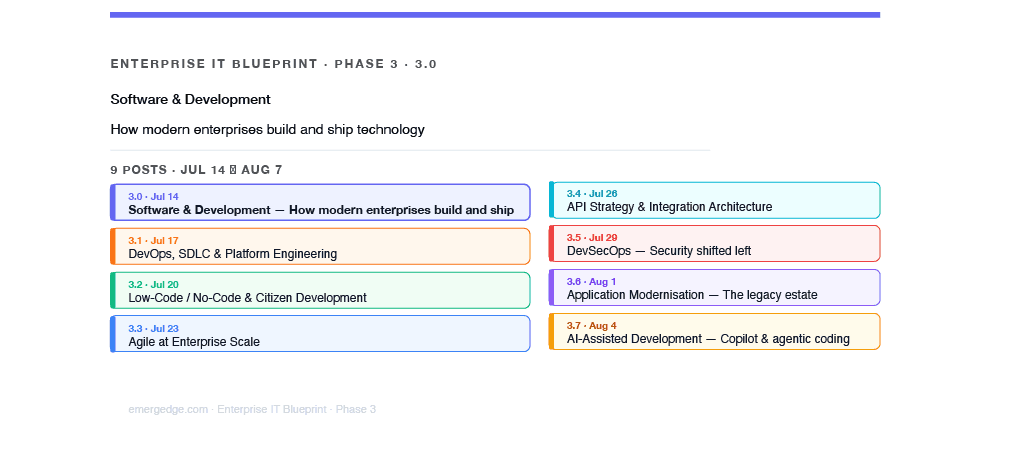
This category covers eight interconnected sub-domains. Together they represent the complete software delivery capability of a modern enterprise.
DevOps, SDLC & Platform Engineering
The cultural and technical shift that defines modern software delivery — continuous integration, continuous deployment, automated testing, and the platform engineering discipline that makes developer experience a first-class concern rather than an afterthought. Post 3.1 covers the full DevOps maturity model, DORA metrics, and platform engineering as an emerging discipline.
Low-Code/No-Code & Citizen Development
The democratisation of application development — enabling business users and non-developers to build solutions using visual development tools without engineering involvement. Post 3.2 covers the governance model, the risks of shadow IT, and the enterprise platforms leading the space: Microsoft Power Apps, Salesforce, OutSystems, and ServiceNow.
Agile at Enterprise Scale
What works when Agile moves beyond a single team — the Scaled Agile Framework (SAFe), LeSS, Scrum@Scale, and the Programme Increment Planning ceremony that synchronises delivery across multiple teams. Post 3.3 covers the failure modes of scaled agile and what organisations that succeed at it do differently.
API Strategy & Integration Architecture
The connective tissue of the modern enterprise — how applications communicate with each other, how data flows between systems, and how organisations manage the portfolio of APIs that their digital capabilities depend on. Post 3.4 covers REST vs GraphQL vs event-driven patterns, API gateway architecture, and the integration platforms leading the enterprise market.
DevSecOps — Security Shifted Left
The transformation of security from a final gate before deployment to an engineering discipline embedded throughout the delivery pipeline. Post 3.5 covers SAST, DAST, software composition analysis, secrets detection, container security, and the governance model for shifting security left without creating developer friction that undermines adoption.
Application Modernisation — The Legacy Estate
Every enterprise has a legacy application portfolio that is simultaneously too expensive to maintain, too risky to replace, and too critical to ignore. Post 3.6 covers the six modernisation strategies, the strangler fig pattern, technical debt measurement, and how to build the business case for modernisation investment.
AI-Assisted Development
The emergence of AI coding assistants — GitHub Copilot, Amazon CodeWhisperer, Cursor, and agentic coding platforms — is changing the economics of software delivery faster than most organisations have planned for. Post 3.7 covers the productivity evidence, the security implications of AI-generated code, the impact on team structure, and what it means for junior developers.
MQ Spotlight — Enterprise DevOps Platforms
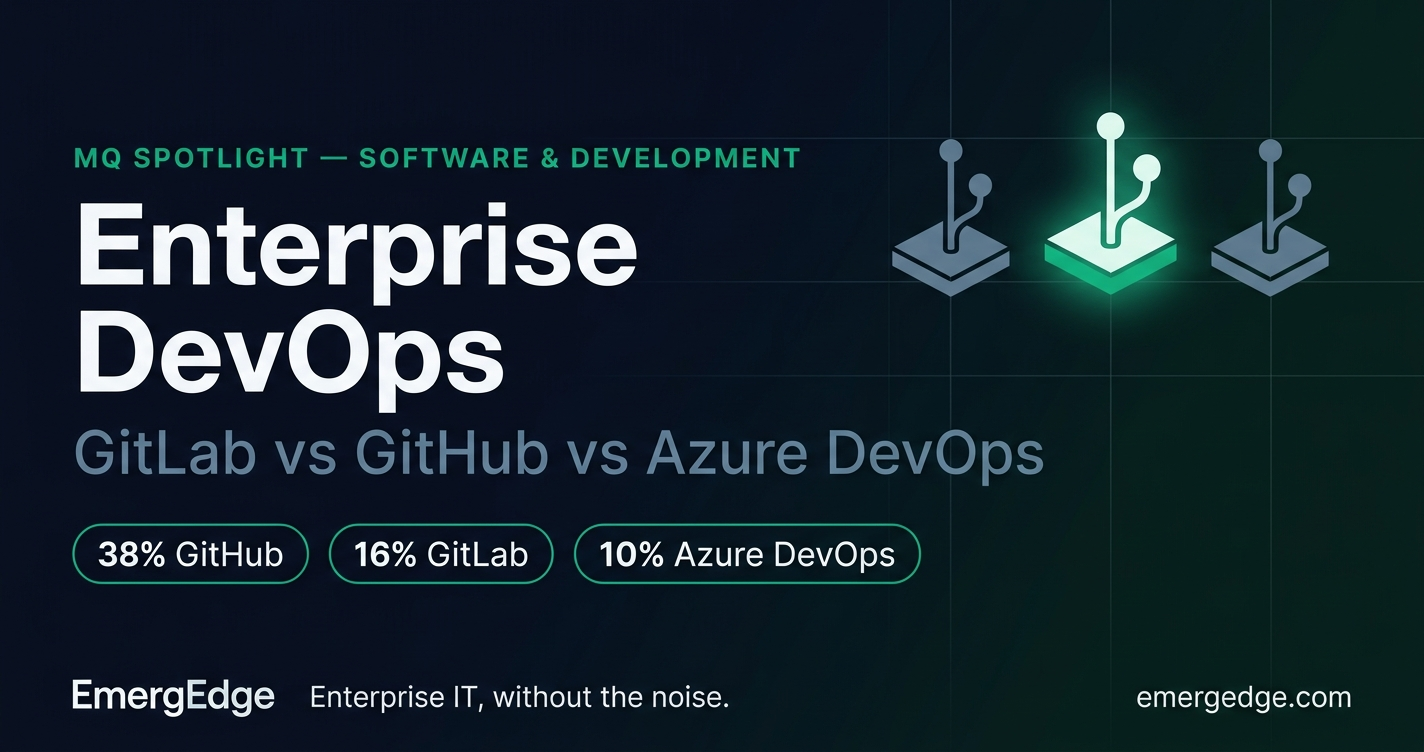
A deep-dive comparison of the leading enterprise DevOps platforms: GitLab, GitHub, Azure DevOps, and Atlassian — across the dimensions that actually determine which platform is right for an organisation's specific context.
What This Category Means for IT Leaders
The organisations that have mastered application delivery are not simply faster. They are structurally more capable of responding to change — which in 2026, with AI reshaping competitive dynamics across every industry, is the most important organisational capability there is.
The IT leader's role in this category is not to become a software engineering expert. It is to create the conditions in which software engineering can thrive — the platform infrastructure, the governance model, the organisational structures, and the investment priorities that determine whether delivery teams can move at the speed the business needs.
Three questions that reveal the current state of application delivery maturity in any organisation:
1. How long does it take from a code change being approved to that change being live in production? In elite organisations, this is measured in minutes. In most enterprises, it is measured in weeks or months. The answer reveals more about software delivery capability than any other single metric.
2. When a production incident occurs, how long does it take to restore service? MTTR (Mean Time to Recovery) is the reliability measure that business stakeholders experience directly — it is the gap between "something broke" and "it is fixed." Elite organisations measure MTTR in minutes. Most enterprises measure it in hours or days.
3. What percentage of the software delivery effort is spent on maintaining existing systems versus building new capability? In most legacy-heavy organisations, the ratio is inverted from what it should be — the majority of capacity goes to keeping the lights on rather than delivering new value. Application modernisation is the discipline that changes this ratio.
The posts in this category are built around those three questions — providing the strategic framework and vendor landscape knowledge that IT leaders need to drive meaningful improvement in each dimension.